FORD BODY SHOP LEWISVILLE, TX
F-150, Super Duty, Ranger, Maverick, Explorer, Expedition, Bronco, Mustang — repaired the way Ford engineered them. That mostly means aluminum: an isolated bay, self-piercing rivets and structural adhesive per Ford’s procedures, and no steel tools near your panels — ever. Genuine Ford parts pushed in writing, Co-Pilot360 recalibrated through our calibration specialists, tinted-clearcoat reds blended right. Free loaner, written lifetime warranty, direct billing to every carrier.
DG Collision Center repairs Fords the way Ford engineered them — and for the trucks, that means aluminum. The F-150’s body has been aluminum since 2015, the Super Duty’s since 2017, and the Expedition’s since 2018, so a real Ford repair runs through a dedicated, isolated aluminum bay with self-piercing rivets and structural adhesive per Ford’s procedures — an investment many DFW shops never made. Genuine Ford parts get argued for in writing, Co-Pilot360 cameras and radar get recalibrated through our calibration specialists with pre- and post-repair scans, and tinted-clearcoat colors like Ruby Red get real blend panels. Direct billing to every carrier; your out-of-pocket is typically your deductible, once.
- F-Series has been America’s best-selling truck for over four decades — and DFW job sites, ranches, and tollways keep ours busy with them.
- Aluminum is the Ford difference — F-150 (2015+), Super Duty (2017+), Expedition (2018+): isolated bay, rivet-and-adhesive joins, never steel tools on aluminum panels.
- Hail on an aluminum hood is a specialist’s job — aluminum work-hardens, so both the technique and the dent count change. Counted under proper PDR lighting here.
- Ford’s hard colors are tinted clearcoats — Ruby Red RR and Rapid Red D4 carry their color in a translucent layer, so film thickness decides the shade. Star White AZ is a true tri-coat.
- Co-Pilot360 triggers calibration — windshield camera, grille radar, BLIS radar in the rear corners — all recalibrated through our calibration specialists with documentation.
- OEM parts have legal backup — Texas Insurance Code §1952.301 bars insurers from dictating parts by brand, type, or condition. We make that argument for you.
Truck Country Runs On Fords — And Fords Run On Aluminum
The F-Series has been America’s best-selling truck for more than four decades, and nowhere is that more visible than North Texas: F-250s hauling to job sites down I-35E, ranch trucks working the country north of Denton, Mavericks and Explorers on every school run in between. What that parade brings through our doors is its own damage catalog — bed-side and tailgate hits, backed-into-trailer creases, job-site mirror strikes, and every spring, hail spread across acres of truck sheet metal. The full aluminum hail playbook — technique, honest costs, the claim — lives on our dedicated F-150 hail damage repair page.
Here’s the part many owners still don’t know: that sheet metal usually isn’t steel. Ford moved the F-150 to an aluminum body in 2015, the Super Duty followed in 2017, and the Expedition in 2018 — and aluminum changes everything about a correct repair. It can’t share tools or airspace with steel work (embedded steel dust causes galvanic corrosion that blooms months later), structural joins use self-piercing rivets and adhesive rather than the welds of the steel era, and dents fight back because aluminum work-hardens as it bends. That’s why our isolated aluminum bay exists — and why a chunk of DFW shops still quietly decline aluminum trucks.
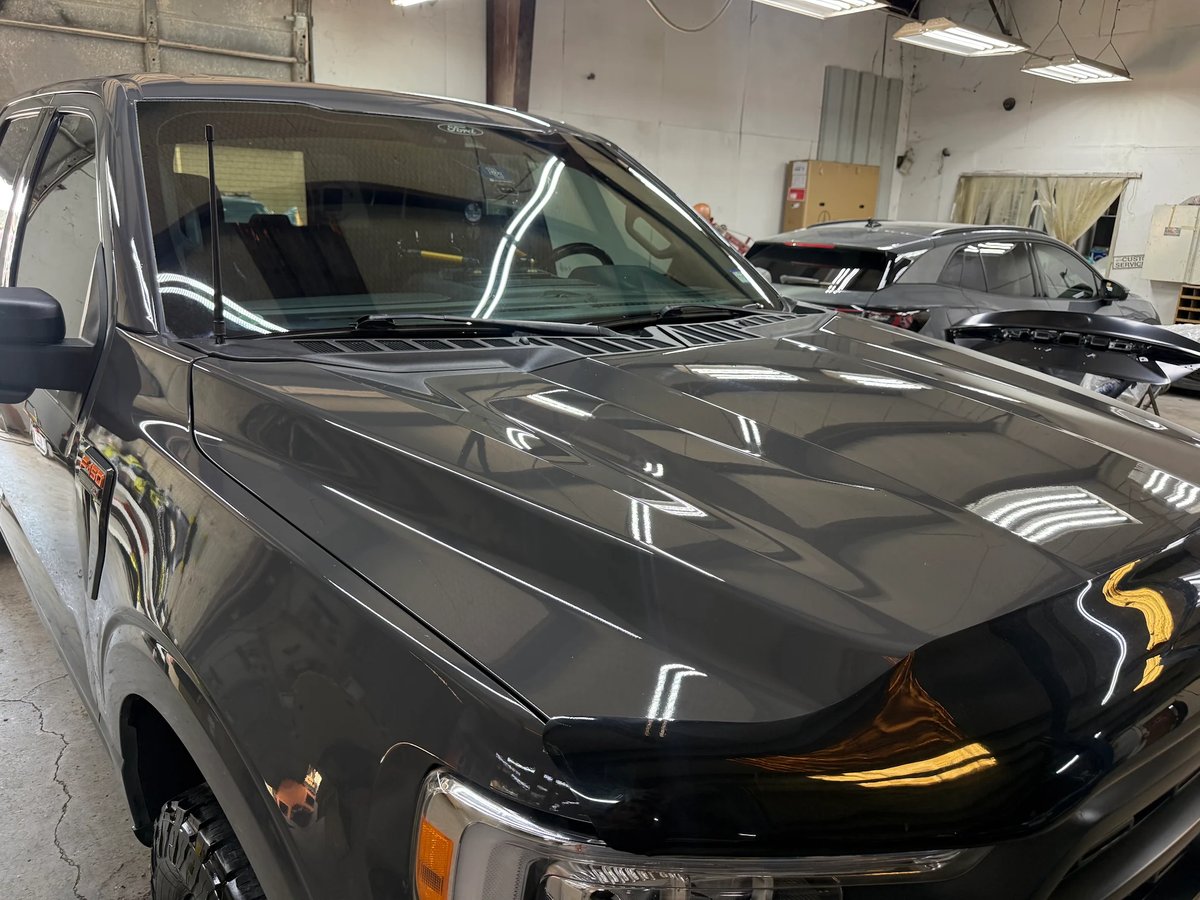
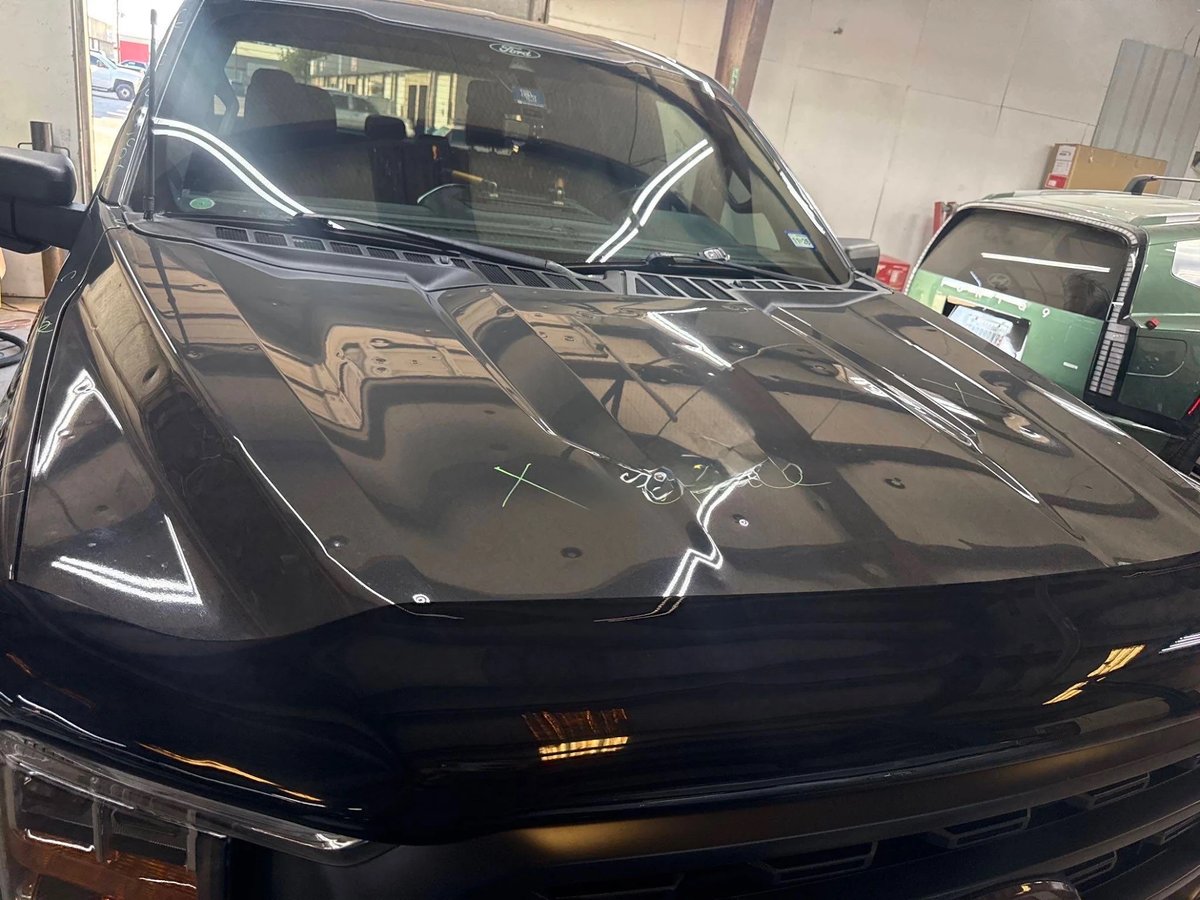
The rest of the Ford story is familiar discipline applied brand-specifically: Co-Pilot360 calibration after windshield, front-end, or rear-corner work; tinted-clearcoat paint that punishes film-thickness mistakes; and high-voltage handling for PowerBoost hybrids, the Lightning, and the Mach-E. Accident or hail, January or April — teardown, blueprint, one documented supplement, direct billing. The hail repair pictured below is a customer’s F-150 — hood counted and marked under PDR lighting, then worked with the aluminum-specific technique those panels demand.
The Lineup
EVERY FORD, AND ITS QUIRKS
Eight models cover most of what DFW drives — each with its own repair personality.
F-150
Aluminum body since 2015 — roughly 700 pounds lighter, and a repair discipline most shops never invested in: isolated bay, self-piercing rivets, structural adhesive per Ford spec. PowerBoost and Lightning add high-voltage steps.
Super Duty F-250 / F-350
Aluminum cab and bed since 2017 on a frame that works for a living. Job-site damage, gooseneck and backing hits — and after a hard pull, real frame measurement on a bench, not eyeballing.
Expedition
The F-150’s aluminum body discipline in three-row form since 2018 — same bay, same rivet-and-bond repairs, plus the door-edge and liftgate wear of full-time family duty.
Explorer
The school-run and rideshare workhorse of DFW — door edges, quarter panels, and liftgates take the abuse, and Co-Pilot360 means the repair isn’t done until calibration passes.
Ranger
The right-sized truck for suburban driveways — steel-bodied, conventionally repaired, with Tremor trims adding trail scrapes and rocker hits to the usual parking-lot catalog.
Maverick
The little unibody truck that’s everywhere now — hybrid in most driveways, which means crumple-zone repairs come with high-voltage precautions in a truck shape.
Bronco
Doors-off summers and trail pinstripes — removable panels make some repairs simpler, and make panel alignment the tell of a careful shop. Rocker and corner hits are the Bronco signature.
Mustang
DFW’s favorite rear-wheel-drive handful — rear-quarter and bumper repairs we see more often than anyone admits. The Mach-E wears the badge too, and brings high-voltage discipline with it.
Ford Paint, By The Code
Ford’s code lives on the door-jamb sticker, and it’s where every refinish starts. The Ford-specific trap is the tinted clearcoat: on colors like Ruby Red and Rapid Red, the color itself rides in a translucent tinted layer over the base — so the film thickness of that layer literally decides the shade. A repair sprayed one coat heavy reads darker than the truck next to it, and no formula fixes what technique got wrong.
Race Red PQ, Iconic Silver JS, Velocity Blue E7, White Platinum Pearl UG — the rest of the Ford deck runs through the same spectrophotometer-and-sprayout process. The gear matters less than the refusal to skip the blend panel when the formula alone “looks close.”
The Ford Repair, By The Book
Five steps, none optional — and on a Ford, step two is the one that separates shops:
1 — Ford’s Procedures Come First
Every repair starts in Ford’s published collision procedures for your exact model and year. Where Ford says replace instead of repair, that’s what happens — and aluminum structural joins follow Ford’s specifications for self-piercing rivets and structural adhesive, not improvised welds.
2 — Aluminum Handled In Isolation
F-150, Super Duty, and Expedition bodies never meet steel tools here. The dedicated aluminum bay runs its own tool set in its own airspace — because steel dust embedded in aluminum causes galvanic corrosion that surfaces months after delivery — and the technicians carry I-CAR aluminum-specific training.
3 — Blueprint At Teardown
Full disassembly of the damaged area, every hidden finding photographed and itemized into one documented supplement. A drive-by estimate prices what a camera can see; a blueprint prices the actual repair — and the difference is paid by the carrier through the supplement process, not by you.
4 — Genuine Ford Parts, Argued In Writing
On structural and safety components we push genuine Ford parts and put the argument to the adjuster in writing. Texas Insurance Code §1952.301 bars insurers from limiting coverage by the brand, type, kind, age, vendor, supplier, or condition of parts — that fight is ours to have, not yours.
5 — Co-Pilot360 Calibration And Scans, Through Our Calibration Specialists
Pre- and post-repair scans run on every job, and Co-Pilot360 components — windshield camera, radar behind the grille, BLIS blind-spot radar in the rear corners — get recalibrated through our calibration specialists with the documentation in your delivery file — scheduled inside the repair timeline, not bolted on after it.
Real Results
AN F-150 HOOD, COUNTED AND REPAIRED
Drag the slider. A customer’s Ford F-150 hood after North Texas hail — every dent counted and marked under PDR lighting, then worked with aluminum-specific technique and delivered without repainting, billed direct to the carrier.
 Before
After
Before
After
F-150 Hood PDR — Hail Claim
Counted and marked under PDR lighting, aluminum technique — deductible once, factory paint preserved
Ford Hit? Hailed On? Send Photos.
Text a few photos with your year and model — we’ll answer with a realistic range, usually within minutes during shop hours. Aluminum or steel, claim filed or not, no obligation.
Common Questions
FORD REPAIR FAQ
Free · No Obligation
START YOUR FORD REPAIR
Tell us which Ford you drive and what happened — we’ll call back with the real number and next steps.
Prefer to talk now? Call (972) 219-0864 · or text us photos
Ford, F-150, Super Duty, Ranger, Maverick, Explorer, Expedition, Bronco, Mustang, Mach-E, F-150 Lightning, BLIS, and Ford Co-Pilot360 are trademarks of Ford Motor Company. DG Collision Center is an independent repair facility and is not affiliated with, sponsored by, or endorsed by Ford Motor Company or its dealers. References are for factual identification only.