HONDA BODY SHOP LEWISVILLE, TX
Civic, Accord, CR-V, Pilot, Odyssey, Ridgeline, Passport, HR-V — repaired to Honda’s book, to the letter. The collision industry’s defining lesson about factory procedures happened right here in Dallas, to a Honda — and it’s why every repair here starts in Honda’s body repair manual: genuine Honda parts pushed in writing, Honda Sensing recalibrated through our calibration specialists, Platinum White Pearl blended right. Free loaner, written lifetime warranty, direct billing to every carrier.
DG Collision Center repairs Hondas to Honda’s published body repair procedures, honored to the letter — because the industry’s defining lesson on cutting corners happened in Dallas: a 2017 jury returned a $31.5 million verdict over a Honda Fit roof that was glued where Honda’s manual called for 104 spot welds. Here, hot-stamped ultra-high-strength steel gets replaced, never straightened; genuine Honda parts get argued for in writing; Honda Sensing cameras and radar — and the LaneWatch mirror camera on older models — get recalibrated through our calibration specialists with pre- and post-repair scans; and Platinum White Pearl gets a real blend panel. Direct billing to every carrier; your out-of-pocket is typically your deductible, once.
- The glued-roof case was a Dallas case, and it was a Honda — $31.5M for skipping 104 factory welds. It’s why “repaired to Honda’s book” is the whole standard here.
- Honda’s crash strategy lives in the steel — hot-stamped ultra-high-strength reinforcement that must be replaced at factory seams, never heated or pulled.
- The LaneWatch quirk: many 2013–2020 Hondas carry a blind-spot camera under the passenger mirror — even a mirror replacement is a calibration event.
- Platinum White Pearl NH-883P is a three-stage tricoat — the most common Honda color in DFW and the most commonly botched. Blend panel, no exceptions.
- Hybrids are Honda’s volume play now — Accord and CR-V two-motor hybrids get HV disable and I-CAR EV-trained hands before structure work.
- OEM parts have legal backup — Texas Insurance Code §1952.301 bars insurers from dictating parts by brand, type, or condition. We make that argument for you.
Why Honda Repair Is A Read-The-Book Discipline
Hondas are what DFW’s most loyal owners drive — Civics and Accords that stay in families for fifteen years, CR-Vs on every commute down I-35E, Odysseys hauling half the youth soccer league. That loyalty is earned by engineering, and the engineering is exactly why Honda collision repair rewards a shop that reads the book: Honda publishes precise body repair procedures for every model, and builds its crash protection into hot-stamped ultra-high-strength steel whose strength comes from how it was formed. Heat it, pull it, or improvise a joint, and that protection quietly disappears.
Nobody should know this better than a Dallas shop. The collision industry’s defining court case happened here in 2017: a jury returned a $31.5 million verdict against a local collision center that had glued a 2010 Honda Fit’s replacement roof with adhesive where Honda’s body repair manual called for 104 spot welds — a hail repair, of all things. Years later the car crashed, and the couple inside was trapped in the burning wreck. That case rewired how serious shops think about factory procedures, and it’s why “the book says 104 welds” ends every debate in our shop before it starts.
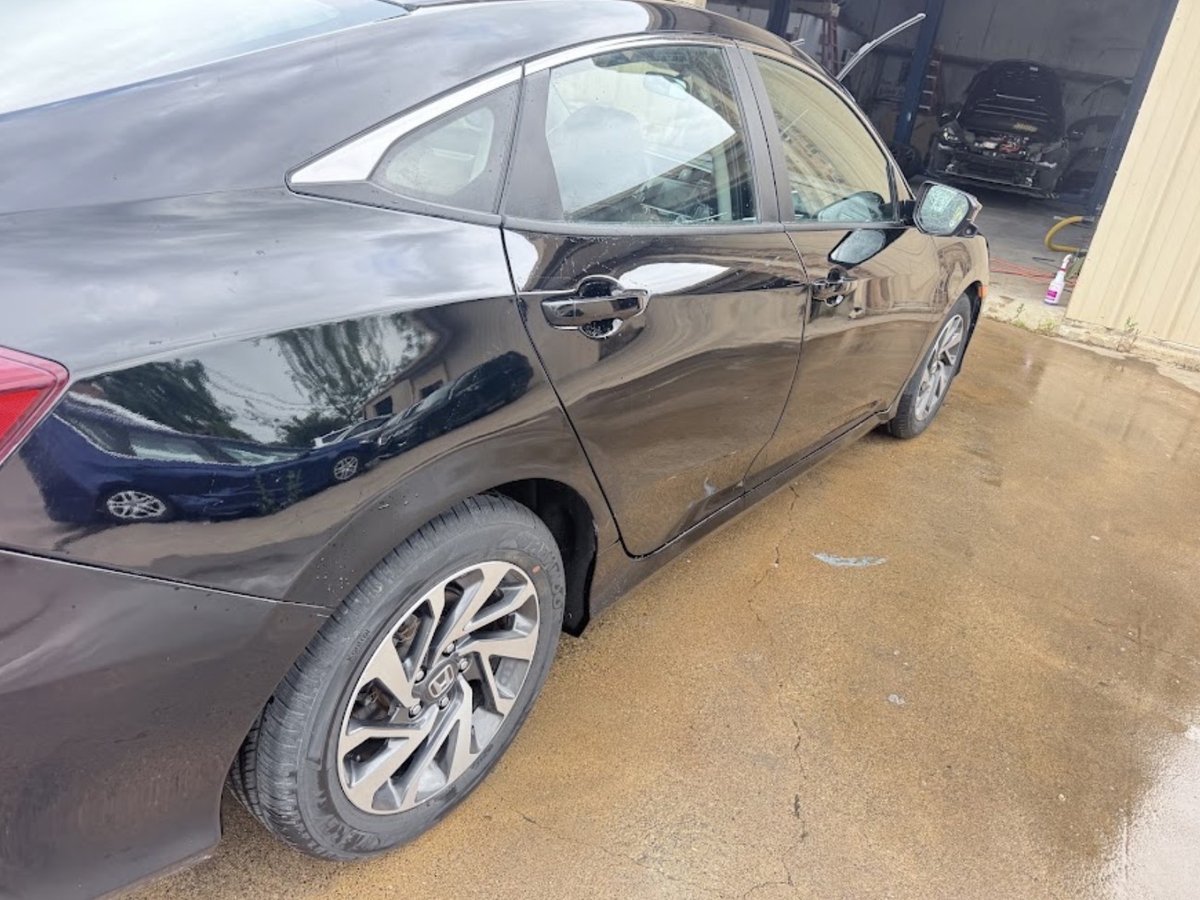
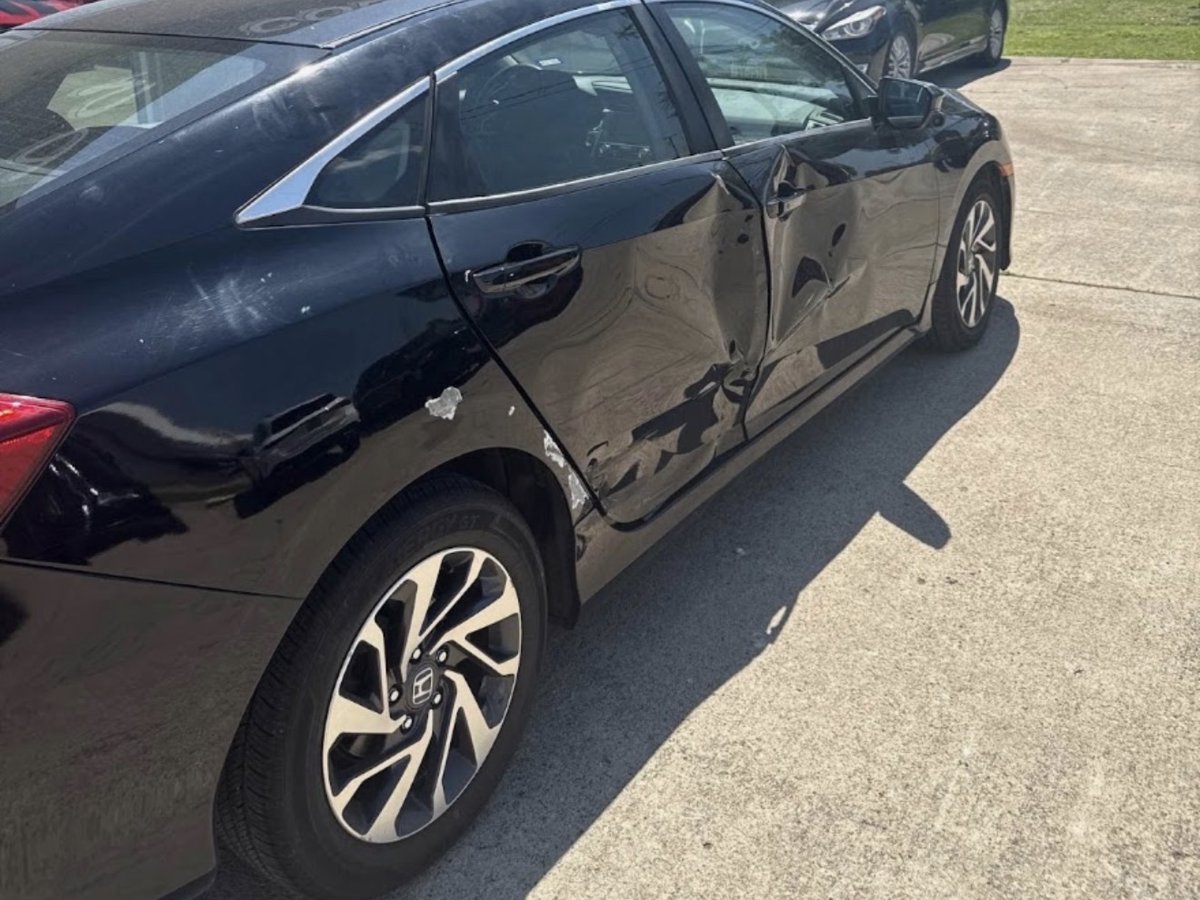
The rest of the Honda story: Honda Sensing calibration after windshield, front, or rear-corner work — plus the LaneWatch mirror camera on many 2013–2020 models that turns even a mirror swap into a calibration event; Platinum White Pearl tricoat paint that punishes shortcuts; and a lineup gone heavily hybrid, which brings high-voltage discipline to everyday collision work. The Civic in the gallery below is a customer’s actual car — accident or hail, January or April, this is what the standard looks like. And when the family badge is the premium one, our Acura body shop page covers the luxury layer of the same discipline — MDX to Type S.
The Lineup
EVERY HONDA, AND ITS QUIRKS
Eight models cover most of what DFW drives — each with its own repair personality.
Civic
The commuter king and our most common Honda repair — rear-enders and side impacts where the door-opening structure decides the plan. Si and Type R add aero pieces and paint that has to disappear into the original.
Accord
Mostly hybrid now, which means HV disable comes before structure work. The fifteen-year-family-car of DFW — and documentation is what keeps a high-mileage Accord’s value honest at trade-in.
CR-V
DFW’s daily driver — parking-lot doors and quarters, tollway rear-enders. Hybrid volume seller, windshield-camera calibration on nearly every repair, LaneWatch mirror camera on the older ones.
Pilot
Three rows of school-run duty — door edges, liftgates, quarter panels. Three rows of passengers is also three rows of reasons the safety systems get verified by scan before delivery.
Odyssey
The sliding-door specialist’s van: those door tracks are precision parts, and a quarter-panel repair that ignores door alignment comes back. Ours don’t.
Ridgeline
The unibody truck — car-like crumple zones in a pickup shape, composite-lined bed with the in-bed trunk. Repairs follow unibody discipline, not ladder-frame assumptions.
Passport
The two-row trail-flavored Pilot — TrailSport trims add rocker scrapes and underbody checks to the usual suburban catalog.
HR-V
The first-car Honda of half of DFW’s new drivers — which means parking-garage rash and first-fender-benders, repaired right so the car outlasts the learning curve.
Honda Paint, By The Code
Honda’s paint code lives on the driver’s door jamb, and the one you’ll see most is NH-883P Platinum White Pearl — on what feels like half the Hondas in the metroplex. It’s a true three-stage tricoat: solid base, translucent pearl mid-coat, clear on top. The pearl layer is the trap — sprayed a pass heavy it reads dark and yellowed next to factory panels, a pass light and it loses the shimmer entirely. Formula gets you close; technique and a blend panel get you invisible.
Whatever the jamb sticker says, the process is the same spectrophotometer-and-sprayout discipline — read the actual panel, prove the mix on a card, and blend into the adjacent panel so there’s no edge for the Texas sun to find.
The Honda Repair, By The Book
Five steps, none optional — and on a Honda, step one carries a Dallas-sized lesson:
1 — Honda’s Procedures Come First
Every repair starts in Honda’s body repair manual for your exact model and year, honored to the letter — if the book says 104 spot welds, it gets 104 spot welds. The $31.5 million Dallas verdict over a glued Honda Fit roof is the industry’s permanent reminder of what skipping that step costs.
2 — Blueprint At Teardown
Full disassembly of the damaged area, every hidden finding photographed and itemized into one documented supplement. Honda’s hot-stamped ultra-high-strength steel must be replaced, never heated or pulled — the blueprint is where those replace-only calls get identified, documented, and paid through the supplement process.
3 — Genuine Honda Parts, Argued In Writing
On structural and safety components we push genuine Honda parts and put the argument to the adjuster in writing. Texas Insurance Code §1952.301 bars insurers from limiting coverage by the brand, type, kind, age, vendor, supplier, or condition of parts — that fight is ours to have, not yours.
4 — Pearl Paint Matched The Tricoat Way
Spectrophotometer reading off your actual panel, the mix proven on a sprayout card, and a blend into the adjacent panel on NH-883P and the other pearls — so there’s no edge to catch the light. That’s the difference between “matches in the booth” and matches in a Texas parking lot at 4pm.
5 — Honda Sensing Calibration And Scans, Through Our Calibration Specialists
Pre- and post-repair scans run on every job, and Honda Sensing components get recalibrated through our calibration specialists — the windshield camera does the heavy lifting, blind-spot radar sits in the rear corners on newer models, and the LaneWatch camera under the passenger mirror on many 2013–2020 Hondas makes even a mirror replacement a calibration event. Documentation goes in your delivery file.
Real Results
A CUSTOMER’S CIVIC, BEFORE AND AFTER
Drag the slider. A customer’s black Civic after a side impact — doors and quarter panel torn down, blueprinted to Honda’s procedures, refinished, and billed direct to the carrier. A real Honda repaired here, not a stock photo.
 Before
After
Before
After
Civic Side-Impact Rebuild — Insurance Claim
Doors and quarter blueprinted at teardown, refinished, scanned — one documented supplement, deductible paid once
Honda Hit? Hailed On? Send Photos.
Text a few photos with your year and model — we’ll answer with a realistic range, usually within minutes during shop hours. Claim filed or not, no obligation.
Common Questions
HONDA REPAIR FAQ
Free · No Obligation
START YOUR HONDA REPAIR
Tell us which Honda you drive and what happened — we’ll call back with the real number and next steps.
Prefer to talk now? Call (972) 219-0864 · or text us photos
Honda, Civic, Accord, CR-V, Pilot, Odyssey, Ridgeline, Passport, HR-V, Honda Sensing, and LaneWatch are trademarks of Honda Motor Co., Ltd. DG Collision Center is an independent repair facility and is not affiliated with, sponsored by, or endorsed by Honda or its dealers. References are for factual identification only.