THE DRIVER WHO HIT YOU HAS NO INSURANCE — NOW WHAT?
It happens more than Texans think — roughly 1 in 8 Texas drivers is uninsured by the state’s own count. With nobody’s liability carrier to bill, your repair runs through your own policy: UMPD coverage with its $250 deductible fixed by statute, or collision coverage at your normal deductible. Suing the driver is possible; collecting from someone who couldn’t afford insurance is the honest problem.
Get the police report — officers verify coverage against the TexasSure database on the spot — then run the repair through your own policy: UMPD pays with a $250 deductible fixed by statute (§1952.105), or collision coverage if you carry it. Roughly 1 in 8 Texas drivers is uninsured, which is exactly why insurers must offer UM/UIM with every Texas policy.
Hit by an uninsured driver in Texas? Get the police report — officers verify coverage against the state’s TexasSure database on the spot — then run your repair through your own policy. Best option: UMPD (uninsured motorist property damage), which pays with a $250 deductible fixed by Tex. Ins. Code §1952.105 — insurers must offer UM/UIM with every Texas policy, and it only disappears if someone named on the policy rejected it in writing. Second option: collision coverage at your normal deductible, though your carrier’s subrogation against an uninsured driver often recovers nothing, so expect that deductible to stay gone. Suing works on paper — Justice Court handles claims to $20,000 — but judgments against the uninsured are hard to collect. Roughly 1 in 8 Texas drivers carries no insurance (TxDMV’s TexasSure estimate: 11.87%), which is the argument for checking your declarations page today, not after.
- UMPD first: $250 deductible by statute — usually hundreds better than your collision deductible.
- Check the rejection trap: a UM rejection signed years ago carries forward through every renewal until you request the coverage back in writing.
- Collision works but costs more: your full deductible, and subrogation against the uninsured usually dead-ends.
- Suing is possible, collecting is the catch: Justice Court to $20,000, two-year window — against a defendant with shallow pockets.
The Odds You’re Playing
UNINSURED DRIVERS ARE A 1-IN-8 PROBLEM IN TEXAS
The state’s own numbers say the quiet part: TexasSure — the verification database that matches every registered vehicle against insurer-reported policies — currently estimates 11.87% of Texas drivers are uninsured, and the Insurance Research Council’s claims-based measure puts it at 13.8%. Call it one driver in eight, on every DFW road you drive. (You’ll see “20%” quoted around the internet; the state’s current data doesn’t support it, and we’d rather under-dramatize.)
The subtler version of the same problem is the driver who is insured — at the floor. Texas minimums are 30/60/25 (Tex. Transp. Code §601.072): $30,000 per injured person, $60,000 per crash, and $25,000 for all property damage. A minimum-limits driver who totals a $45,000 truck is uninsured for the second half of your loss, which is what “underinsured” means and why the coverage is sold as one package: UM/UIM. Everything below about claiming against your own policy applies to both flavors — the driver with nothing, and the driver whose limits run out before your damage does.
Ranked, Honestly
YOUR FOUR OPTIONS, RANKED
Notice what’s missing from that table: any requirement that you were perfectly insured. Texas has no “no pay, no play” law — nothing conditions your right to pursue an at-fault driver on your own coverage status. But as a practical matter, options 1 and 2 are the ones that reliably fix cars, which makes your declarations page the real battlefield. If you filed on collision because the driver was found but uninsured, the subrogation-and-deductible mechanics — including why that refund usually won’t come — are covered in our deductible-back guide. And if the driver didn’t just lack insurance but left entirely, that’s a different playbook: our hit-and-run guide covers the phantom-driver path.
UNINSURED DRIVER, REAL DAMAGE? GET THE NUMBER THAT DECIDES EVERYTHING.
Free written estimate — the document your UMPD claim, your collision claim, or your Justice Court filing all start from.
The Coverage Built For This
UMPD FINE PRINT WORTH KNOWING BEFORE YOU NEED IT
Texas takes uninsured motorist coverage seriously enough to legislate the details. Insurers must include UM/UIM coverage with every auto liability policy unless a named insured rejects it in writing (Tex. Ins. Code §1952.101) — and here’s the trap in that clause: the rejection carries forward. Decline it once, and every renewal with that insurer or an affiliate stays declined until you request the coverage back in writing. Anyone named on the policy can have signed that rejection — a spouse, years ago, chasing a lower premium. If you’re not certain, the answer is one declarations page away, and it’s worth looking today: one driver in eight is the wrong odds to discover a signature from 2019.
The property-damage side, UMPD, comes with a deductible of exactly $250 — set by §1952.105, not by your policy tier, and not something an insurer can waive or inflate. TDI states it just as plainly in its consumer guidance. Compare that against a typical $500–$1,500 collision deductible and UMPD is usually the cheapest door into your own repair by a wide margin. It quietly covers the hit-and-run scenario too — with one wrinkle: when the driver is unknown, the law requires actual physical contact between their vehicle and yours or you (§1952.104), so a phantom swerve without a touch runs through collision instead. UM/UIM can even pick up rental costs on some claims, which pairs with the coverage math in our rental-car guide — the two policy lines worth reviewing in the same sitting.
The Other Side Of The Ledger
WHAT THE UNINSURED DRIVER IS ACTUALLY FACING
Less than you’d hope, which is worth knowing before you build a recovery plan around punishing them. Driving without financial responsibility is a misdemeanor: a fine of $175 to $350 for a first offense, climbing to $350 to $1,000 with priors (Tex. Transp. Code §601.191) — and courts can even reduce a first fine below $175 for inability to pay. The officer at your crash scene checks coverage against TexasSure in real time, so the citation half of this is nearly automatic. But a traffic fine payable to the county does nothing for your quarter panel.
Your civil claim against them survives regardless — two years to file for property damage, with Justice Court handling anything up to $20,000 cheaply and without lawyers required. The honest calculus is collectability: a judgment against someone who couldn’t sustain a liability premium is a document, not a check, and enforcing it costs time and fees against assets that may not exist. That’s not a reason never to sue — some uninsured drivers have jobs, equity, and every reason to settle once served — it’s a reason to file your UMPD or collision claim first and treat the lawsuit as upside rather than rent money. It’s also the whole argument for UM/UIM coverage existing: the legislature knew the fine print of §601.191 fixes nobody’s bumper. The broader after-crash sequence — scene documentation, adjusters, timelines — lives in our Texas accident guide whenever you need the wider map.
The Playbook
HIT BY AN UNINSURED DRIVER — 5 STEPS
01. Lock down proof at the scene
Police report, photos, their name, plate, and phone. The officer’s TexasSure check documents the no-insurance fact for you — that report line is your claim’s foundation.
02. Pull your declarations page
Look for UM/UIM property damage. If it’s missing, find out whether a written rejection is on file — it carries forward until you reverse it, and now is the moment to know.
03. File the cheaper claim
UMPD’s statutory $250 deductible usually beats collision by hundreds. File promptly, hand over the police report, and let the shop bill your carrier direct.
04. Treat the lawsuit as upside
Justice Court takes claims to $20,000 and you have two years — but collectability decides whether it’s worth the filing fee. Repair through coverage first; sue second, if at all.
05. Repair with a court-grade file
Line-item estimate, teardown photos, clean invoice — the same documentation that satisfies your adjuster is what proves damages if the driver ever does get sued or settles.
From Our Shop Floor
THE REPAIR NOBODY ELSE WAS GOING TO PAY FOR
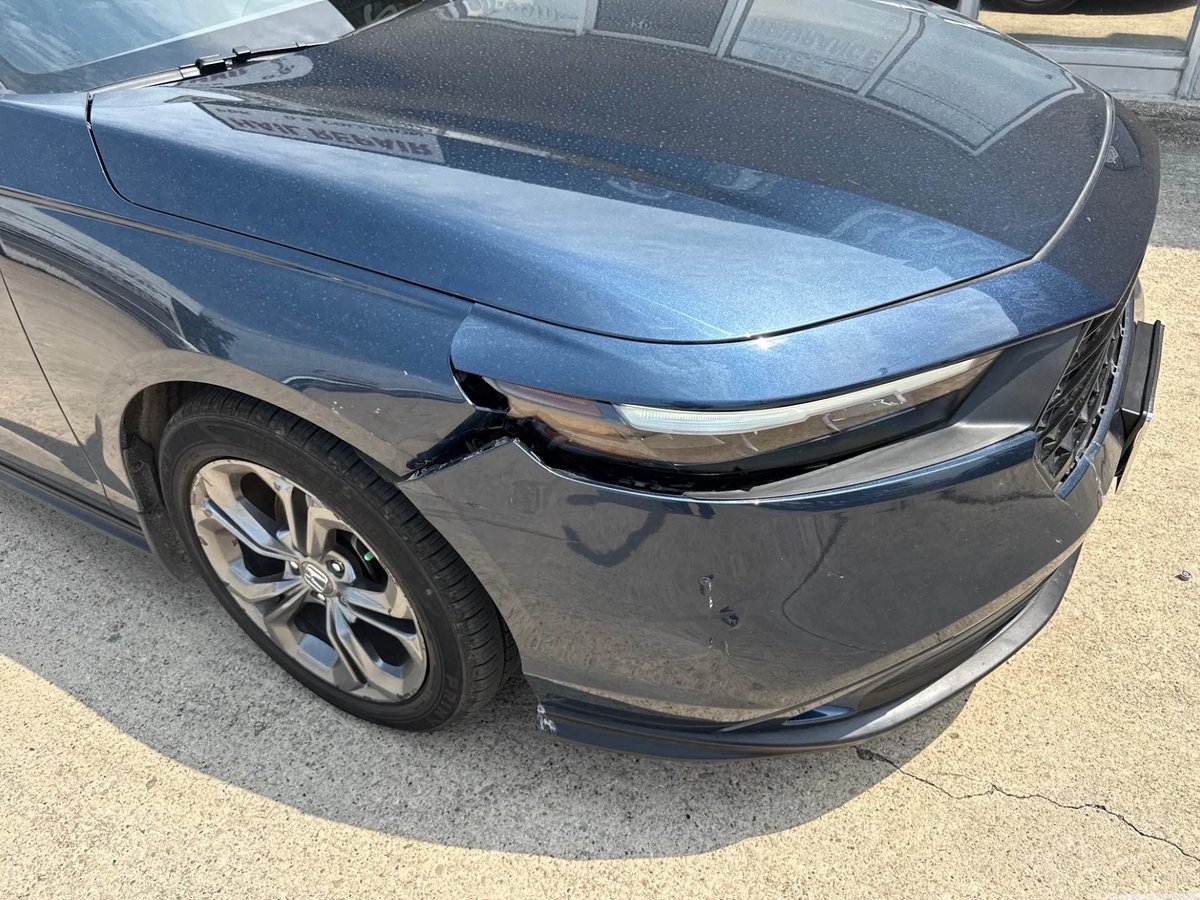
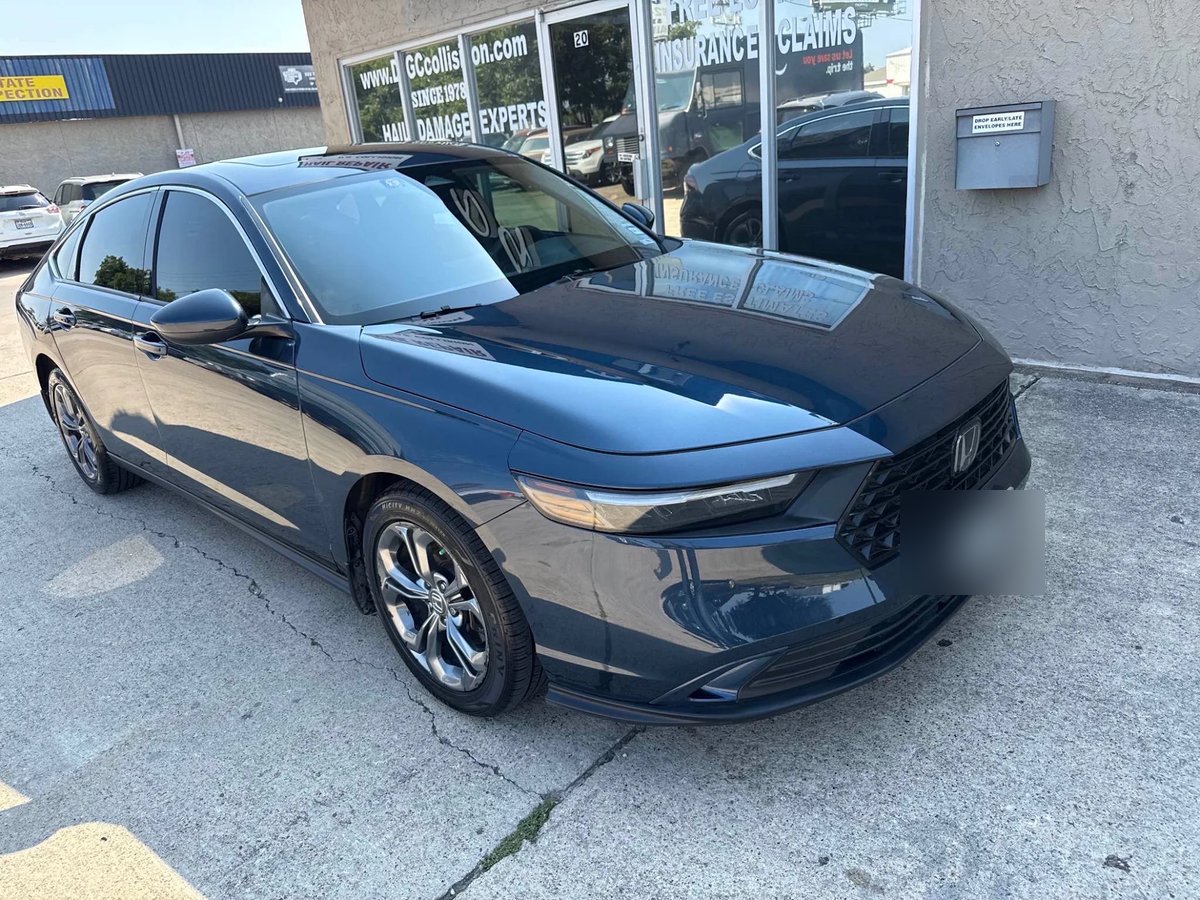
Drag the slider — a real front-end repair from our Lewisville floor: bumper, fender, and headlight brought back to factory fit and finish.
 Before
After
Before
After
Front-End Hit — Bumper, Fender & Headlight
Pictured: Honda Accord — front-corner damage repaired, refinished, and delivered back at our Lewisville storefront
Uninsured-Driver Questions