ACCIDENT IN A LEASED OR FINANCED CAR — WHAT CHANGES?
One thing, mostly: you’re not the only party with a stake in the repair. The bank or lease company sits on the title, so the insurance check usually names you both, the contract requires full coverage, and a lease adds a turn-in inspection that charges for bad repairs years later. What doesn’t change: the shop choice is still yours — Texas law keys that right to the policyholder, not the title.
The lender is a silent party to the whole claim: your contract requires collision and comprehensive coverage, claim checks name you and the lienholder together, and the lender can require repair before releasing the money. On totals, they’re paid first. The repair-shop choice is still yours (§1952.301) — the bank picks neither the shop nor the parts.
On a financed or leased car, the lender or lessor is a silent party to every repair. Your contract requires collision and comprehensive coverage (TDI’s guide says so plainly), and dropping them triggers force-placed insurance that’s expensive and protects only the lender. Claim checks typically name you and the lienholder together — both signatures required — and the contract lets the lender insist the money becomes a repair. Leases raise the stakes at turn-in: Toyota’s published wear standards charge for “previous repairs performed poorly or unrepaired collision damage,” and Honda’s guide counts touch-up paint as unrepaired damage — so a cheap fix gets paid for twice. Your rights hold steady through all of it: Texas Ins. Code §1952.301 and the state’s Consumer Bill of Rights give the policyholder — not the bank — the choice of repair shop and parts. And if the car is totaled while you still owe on it, the insurer typically pays the lienholder first; GAP coverage exists for the difference.
- The check names you both: two signatures to cash, and the contract lets the lender steer the money into the repair.
- Lease turn-in is a second judgment day: poor-quality repairs and unrepaired damage are chargeable by the lessors’ own published standards.
- Shop choice stays yours: §1952.301 keys the right to the policyholder — no ownership condition.
- Totaled while owing: lienholder gets paid first; GAP covers a payoff bigger than the car’s value.
Read Your Contract Once
THE SILENT PARTY ON YOUR TITLE
Finance a car and the lender records a lien; lease one and the company outright owns it. Either way, your contract almost certainly requires you to carry the two coverages Texas law never does: TDI’s guide states it flatly — “if you still owe money on your car, your lender will require you to have collision and comprehensive coverage” — and the state’s Consumer Bill of Rights notes the same thing as a standard loan condition. Let those coverages lapse and the contract’s teeth show: the lender buys collateral protection insurance on your behalf, adds it to your payment, and must tell you within 31 days of charging it (Tex. Fin. Code §§307.051–.052). TDI’s description of that product is all you need to know about it: “expensive and protects only the lender.”
Here’s what the silent party does not get to decide: where the car gets fixed. Texas Ins. Code §1952.301 bars insurers from limiting “the beneficiary of the policy” in selecting a repair shop — the right runs to the policyholder, with no ownership condition anywhere in the text — and the TDI-adopted Consumer Bill of Rights says it in plain English: “You have the right to choose the repair shop and replacement parts for your vehicle.” A lease can hold you to repair quality standards (more on that exam below), but the shop decision belongs to the person holding the policy: you.
Two Names, Two Signatures
HOW THE TWO-NAME CHECK ACTUALLY CLEARS
When a financed car takes damage, the insurance payment usually arrives made out to you and the lienholder — the State Bar’s consumer guidance describes it directly: claim payments on financed property “will be made payable to you and the lienholder, and the checks would require signatures from both parties.” That’s the loss-payable clause in your policy doing its job: the lender’s interest rides on the title, so the lender’s name rides on the check. No Texas statute forces this arrangement — it’s contract machinery — but it’s near-universal, and it’s the mechanism that lets a lender insist the money becomes a repair rather than a vacation. (On an owned, paid-off car the calculus is completely different — that freedom is the subject of our keep-the-check guide.)
Practically, the two-name check adds a step, not a wall. Most lenders endorse promptly once the repair is documented — a written estimate from the shop, sometimes an inspection or a copy of the final invoice; captive lease companies are typically even faster because a repaired car protects their own asset. Two things keep the step small. First, direct shop billing: when we bill the carrier directly, the endorsement paperwork runs shop-to-lender-to-carrier without the check ever sitting in your junk drawer. Second, Texas’s prompt-payment deadlines still bind your insurer on the claim itself (Ins. Code ch. 542) — the lienholder’s signature requirement doesn’t pause the insurer’s clock to accept and pay. If a lender drags its feet on endorsement, escalate inside the lender — loss-payee departments have supervisors, and “your collateral is sitting unrepaired” is an argument they respond to.
BANK ON THE TITLE? WE HANDLE THAT PAPERWORK DAILY.
Direct carrier billing, lender endorsement coordination, and a repair documented to turn-in standard — starting with a free written estimate.
Years Later, Someone Grades The Repair
THE TURN-IN EXAM EVERY LEASE REPAIR EVENTUALLY TAKES
A leased car’s repair gets judged twice: once when you pick it up, and again — by a stranger with a clipboard — at lease end. The lessors publish their grading standards, and they’re stricter than most drivers assume. Toyota Financial’s wear-and-use guide lists “previous repairs performed poorly or unrepaired collision damage” as chargeable, alongside any dent or paint-penetrating scratch bigger than a credit card. Honda’s inspection guide is even more exacting: scratches a fingernail can catch, any scratch over three inches, more than two scratches per panel, all windshield cracks — and this quietly devastating line: “touch-up paint is considered unrepaired damage.” The Federal Reserve’s leasing guide sums up the category the same way: excessive wear includes “poor-quality repairs or repairs that do not meet the lessor’s standards.”
The strategic takeaway: on a lease, a cheap repair isn’t cheap — it’s a deposit on a second bill. Mismatched paint, wavy panel lines, or a bumper that was touched up instead of refinished all read as chargeable damage at inspection, which means you pay once for the bad repair and again for the inspector’s opinion of it. Factory-standard work — proper blends, correct panel fit, finish that matches under an inspector’s light — is the only version that closes the file, and the parts-quality half of that equation is covered in our OEM-vs-aftermarket guide. Keep every invoice: Honda’s own guide tells lessees to bring receipts for completed repairs to turn-in, and a documented, warranted repair is exactly the paper that ends a wear-charge argument. One more lease-specific note: diminished value on a leased car generally isn’t your claim to make — the value loss lives with the title holder — so your real exposure is these wear charges, not resale math. (Own your car instead? The diminished-value guide is yours.)
When The Math Goes Underwater
TOTALED WHILE YOU STILL OWE
A total loss on a financed car pays out in a strict order: OPIC’s consumer guidance says it plainly — “typically, the company will then pay the lienholder first. If you owe less than the car is worth, you will get the difference.” The dangerous sentence is the unspoken mirror image: owe more than the car’s actual cash value, and the insurance money runs out before the loan does — leaving you making payments on a car that no longer exists. Depreciation makes this common in the first years of a loan, especially with small down payments and long terms.
GAP coverage is the product built for that hole. TDI’s guide describes it as the answer when the total-loss payment “might not be enough to pay off your loan,” and the CFPB adds a consumer protection worth knowing: a lender generally can’t force you to buy GAP from them as a loan condition unless the contract explicitly requires it — you can shop for it, often cheaper through your own insurer than the dealer’s finance office. Whether a given repair estimate is even approaching total-loss territory is its own math — Texas’s 100% formula, ACV negotiation, salvage trade-offs — and that lives in our total-loss guide. If you’re staring at a payoff letter and an ACV offer right now, read it before signing anything.
The Playbook
LEASED-OR-FINANCED REPAIR IN 5 STEPS
01. Read the insurance clause once
Your finance or lease contract names the required coverages and may cap your deductible — know those two lines before you ever need them, and keep the coverage alive to dodge force-placed insurance.
02. File normally — expect two names
Open the claim like any owner would. The check naming you and the lienholder is standard machinery, not a problem — direct shop billing keeps the endorsement loop out of your hands.
03. Choose your shop — it’s your right
Texas law gives the policyholder the choice of repair shop and parts. Neither the insurer, the lender, nor the lease company picks for you — pick the shop whose work passes inspections.
04. Repair to the standard that gets graded
On a lease, build the repair for the turn-in inspector: factory color match, correct panel gaps, no shortcuts — and keep every invoice, because receipts end wear-charge arguments.
05. If it totals, mind the gap
The lienholder gets paid first from the settlement. Pull your payoff letter, check for GAP coverage, and negotiate the ACV before accepting — the difference is your money either way.
From Our Shop Floor
A REPAIR BUILT TO PASS INSPECTION
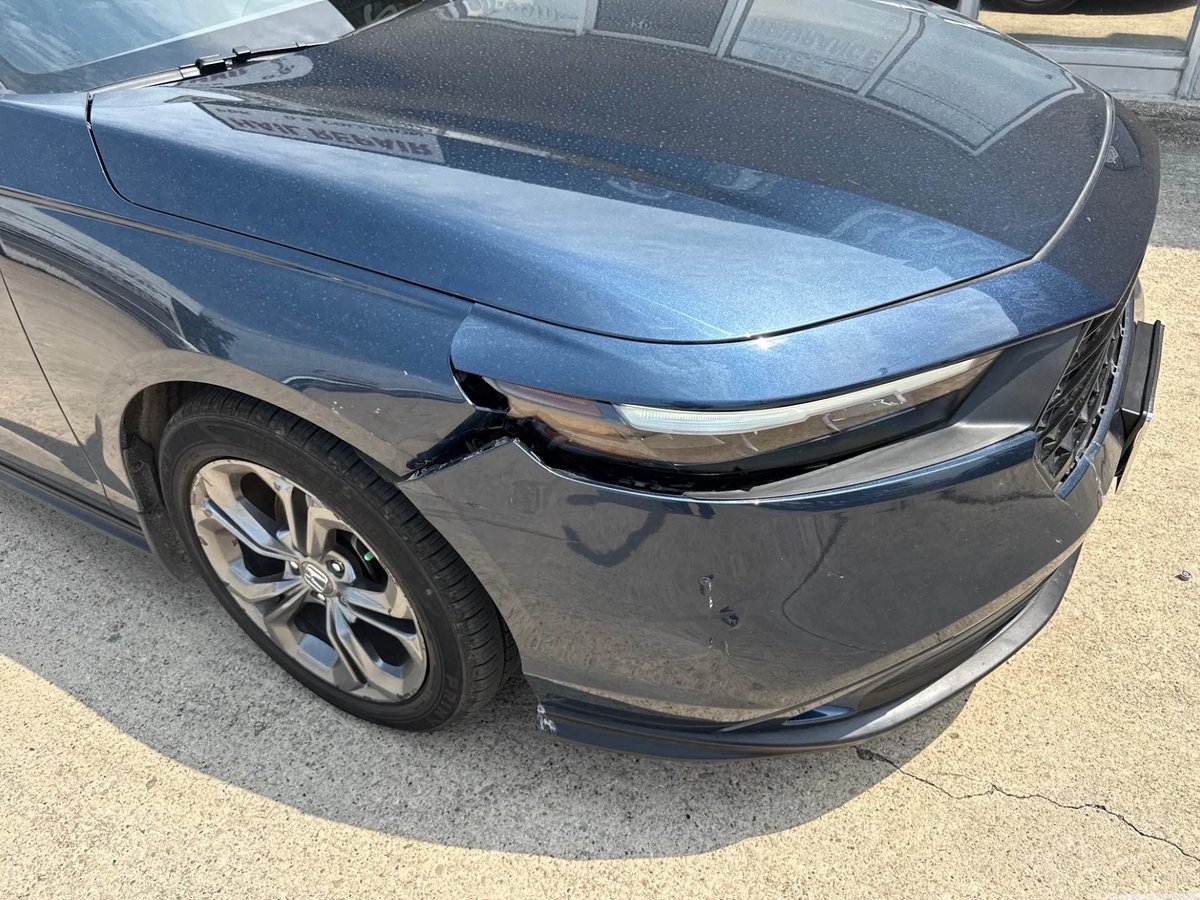
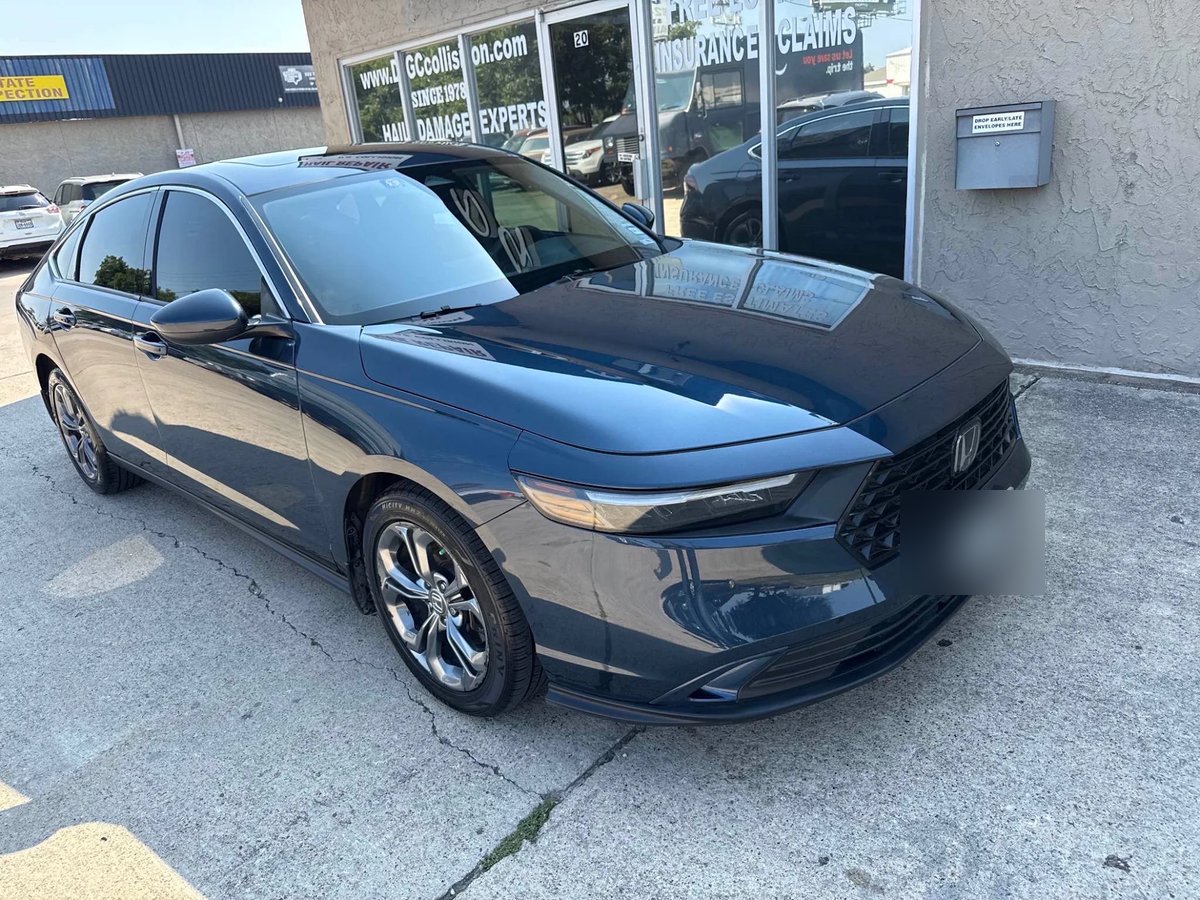
Drag the slider — a real front-corner repair from our Lewisville floor, finished to the factory match a lease inspector’s light can’t catch.
 Before
After
Before
After
Front-Corner Hit — Bumper, Fender & Headlight
Pictured: Honda Accord — front-corner damage repaired and refinished to factory match, documented invoice included
Leased & Financed Questions