THE APRIL 25–28, 2026 DFW HAIL OUTBREAK: FOUR DAYS, FIVE ROUNDS
Yes — hail hit the DFW area on all four days from Saturday, April 25 through Tuesday, April 28, 2026. The National Weather Service logged 195 hail reports across the outbreak: 3.00-inch stones in Azle, Lakeside and Cockrell Hill, measured golf-ball hail in Richardson, 2.00-inch in Rowlett, half-dollar hail over Keller and Southlake — and a 4.50-inch monster near Godley on the final evening.
From Saturday April 25 through Tuesday April 28, 2026, five separate rounds of hail crossed the DFW area on four calendar days — 195 NWS-verified reports in total, 69 of them inside Tarrant, Dallas or Collin County. Round 1 hammered west Tarrant late Saturday night (3.00″ at Azle and Lakeside, fourteen reports around White Settlement); Round 2 continued past midnight into Sunday over Fort Worth (2.75″) and southwest Dallas County (3.00″ at Cockrell Hill); Round 3 hit the US-75 corridor at dawn Sunday (4.00″ at Trenton, broken windows in Leonard); Round 4 crossed Richardson, Murphy, Rowlett and Rockwall Monday evening; and Round 5 clipped Keller and Southlake Tuesday before dropping a 4.50″ stone near Godley. If your car was outside on any of those four days, the tables below tell you which round to check against.
- Biggest verified stones: 4.50″ near Godley (Apr 28) · 4.00″ Trenton (Apr 26) · 3.50″ Bells & Commerce · 3.00″ Azle, Lakeside & Cockrell Hill.
- Metro cities with verified hail: Fort Worth, White Settlement, Benbrook, Lake Worth, Azle, Arlington-Kennedale-Pantego, Grand Prairie, Duncanville, Cockrell Hill, Richardson, Rowlett, Murphy, Saint Paul, Rockwall, Fate, Keller, Southlake, Farmers Branch, Addison, University Park.
- The midnight trap: the “Saturday night” storm crossed midnight — damage in Fort Worth and Dallas County after 12:00 AM carries a date of loss of April 26, not April 25.
- Claims are still open season: hail is comprehensive, late discovery is normal, and 28 TAC §5.7016 bars nonrenewal solely over weather claims.
Round 1 · Saturday Night
APRIL 25: WEST TARRANT TAKES 3-INCH HAIL BEFORE MIDNIGHT
The outbreak opened Saturday evening over Wise and Parker counties — Runaway Bay logged stones up to 2.75″ by 8:47 PM, Aledo 2.50″ — then the cells rode into western Tarrant County. Between 10:10 PM and 11:48 PM the NWS logged more than two dozen reports in a tight corridor: 3.00″ hail at Azle and at Lakeside, a fourteen-report barrage around White Settlement topping at 2.75″, and hen-egg-class stones over Benbrook and Westover Hills. (A separate pre-dawn cluster that same calendar day dropped 2.00″ hail out east around Grand Saline — the outbreak bracketed the metro from both sides.)
Curated from the 46 hail reports the NWS logged that calendar day; times converted to Central. Full federal record: SPC storm reports, April 25, 2026.
Rounds 2 & 3 · Past Midnight + Dawn
APRIL 26: THE SAME STORM CROSSES MIDNIGHT INTO FORT WORTH & DALLAS
The Saturday-night line didn’t stop at the Tarrant County line — it crossed midnight. Between 12:30 and 1:26 AM, now officially April 26, the NWS logged 2.75″ hail over north Fort Worth, quarter-size through Haltom City, Richland Hills and Sansom Park, 3.00″ hail around Cockrell Hill in southwest Dallas County, 2.00″ near Lake Arlington in Kennedale, and golf-ball hail over Pantego — with Grand Prairie, Duncanville and south Arlington all logging quarters. If you woke up Sunday to a dented car anywhere in that corridor, this is your round.
Then, before sunrise, a third round rode the US-75 corridor along the outbreak’s northern edge: quarter-size across Denison and Sherman starting 4:27 AM, 3.50″ at Bells at 6:18 AM, hail that the NWS log says damaged trees and cars in Tom Bean, golf balls in downtown Whitewright — and at 6:40 AM, 4.00″ stones photographed in Trenton, with the log recording “numerous homes and cars had windows broken” from baseball-size hail in the Whitewright–Trenton–Leonard corridor.
37 reports on the April 26 calendar day. Heads-up when checking the federal record: SPC report pages run on a noon-to-noon UTC clock, so the past-midnight and dawn rounds appear on the April 25 SPC page.
Round 4 · Monday Evening
APRIL 27: RICHARDSON, MURPHY, ROWLETT & ROCKWALL AT COMMUTE’S END
After a daytime break, Monday evening’s round formed over northeast Dallas County at 7:18 PM and worked east along the PGBT corridor — prime just-got-home parking-lot and driveway exposure. Richardson took the densest cluster, including a measured 1.75″ stone; Murphy and Saint Paul logged quarters and half-dollars on Plano’s eastern doorstep; Rowlett reached 2.00″; and in Fate the NWS log records hail “large enough to leave holes in a metal roof.” The round finished with 3.50″ hail near Commerce in Hunt County.
32 reports on the day. Full record: SPC storm reports, April 27, 2026.
YOUR CAR WAS OUT IN ONE OF THESE ROUNDS? GET IT IN WRITING.
Ten minutes under PDR lighting turns “I think it got hit in April” into a documented, dated dent count. Free, no obligation to file.
Round 5 · Tuesday
APRIL 28: KELLER & SOUTHLAKE CLIPPED — AND A 4.50″ MONSTER NEAR GODLEY
The outbreak’s final day was its busiest — 80 NWS reports from Montague County down to Waco. The heaviest hail stayed west and south of the core metro (Millsap and Brock in Parker County took 2.75″ and tennis-ball stones; Cleburne 3.00″), but the metro didn’t escape: at 5:26 and 5:35 PM the Keller emergency manager and multiple social-media photos verified quarter to half-dollar hail across Keller, with matching photos out of Southlake at 5:37 PM, then dime-size clipping Farmers Branch, Addison and University Park around 6 PM. Twenty minutes later, southwest of the metro, the log turns violent: 3.00″ wind-driven hail breaking home windows near Godley, a photo-measured 3.50″, and at 6:39 PM a trained spotter’s 4.50″ stone on Highway 171 between Cresson and Godley — the largest verified hail of the entire outbreak.
Curated from 80 reports on the day. Full record: SPC storm reports, April 28, 2026.
The Question Adjusters Actually Ask
WHICH DATE GOES ON YOUR CLAIM WHEN THE STORM CROSSED MIDNIGHT?
Here’s the trap built into this outbreak: everyone in Fort Worth and southwest Dallas County remembers “the Saturday night storm.” But the NWS log shows the line crossing midnight — north Fort Worth’s 2.75″ report landed at 12:35 AM and Cockrell Hill’s 3.00″ at 12:51 AM, which makes the official date of loss April 26, not April 25. West Tarrant damage (Azle, White Settlement, Benbrook, Westover Hills) belongs to April 25; Fort Worth proper and Dallas County damage from that same night belongs to April 26.
Does it matter? Usually only for verification speed — but that’s exactly where late claims stall. Carriers match your date of loss against catastrophe-event records for your address; give a date their weather data doesn’t support and the claim gets kicked to manual review, adding days or a skeptical adjuster. The fix is simple: put your best-known date on the claim, and if the storm hit around midnight, say so — “the night of April 25–26” is language adjusters understand, and this page plus the SPC records linked above are the receipts. If a claim rep insists nothing happened on your date, point them one calendar day in either direction before you accept a denial.
And a quirk of the federal record worth knowing: SPC’s daily report pages run noon-to-noon UTC, so the entire Saturday-night-into-Sunday sequence — including the 12:51 AM Cockrell Hill stone and even the dawn hail up in Grayson County — files under the April 25 SPC page. Don’t let that convince you your Sunday 1 AM damage “didn’t happen” on the 26th.
Half-Dollar To Softball-Class
WHAT THIS OUTBREAK’S SIZES DO TO A CAR
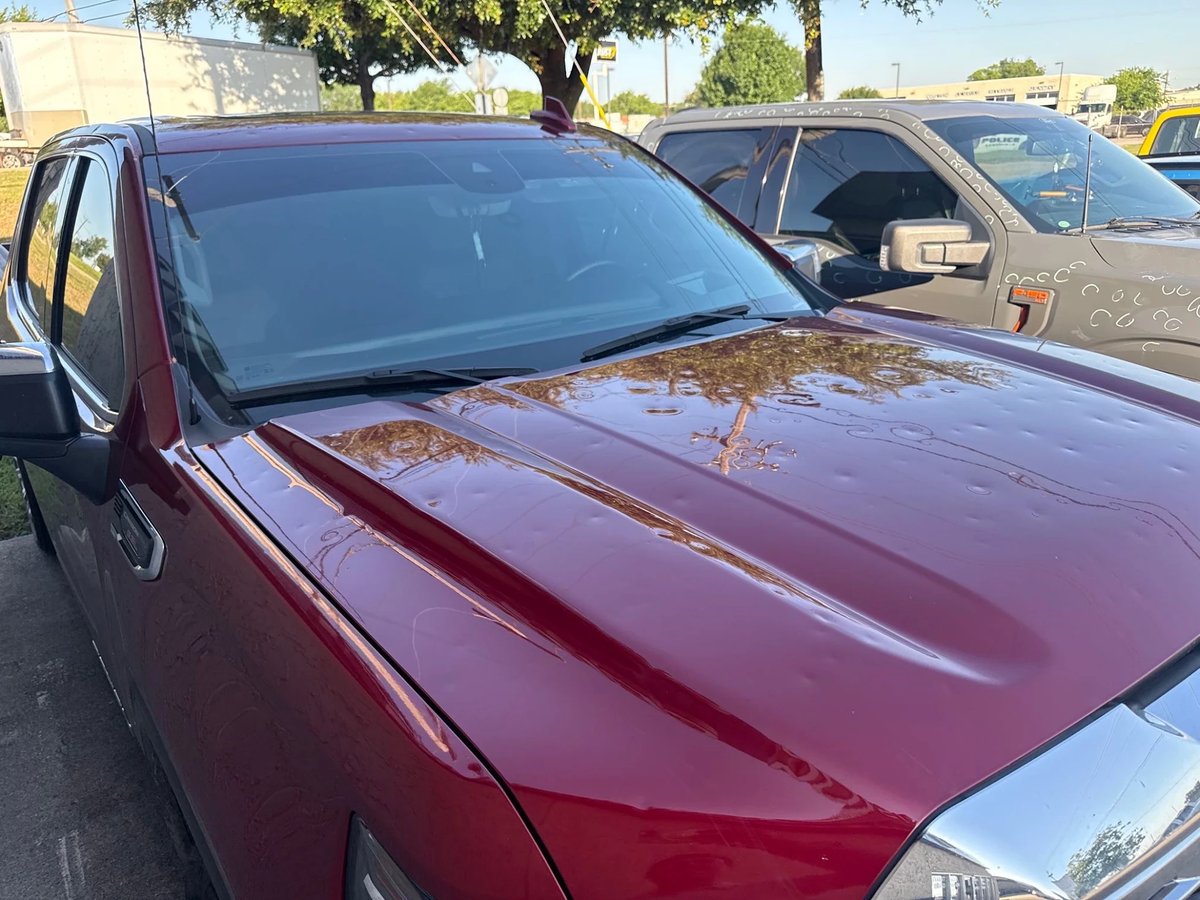
This outbreak ran the entire damage spectrum, so match your area’s verified size to what we see at the estimate bay. Keller, Southlake and the Tollway corridor (0.50–1.25″): dime-size usually leaves steel panels alone; quarter-to-half-dollar is right at the threshold where hoods, roofs and trunk lids start collecting shallow dents — counts of 30–100 are routine, and this is textbook paintless dent repair territory: factory paint stays, typically 3–7 days.
Richardson, Rowlett, Kennedale, Benbrook (1.75–2.25″): golf-ball and hen-egg stones dent vertical panels too — doors and fenders — crack mirror caps and trim, and start stretching metal on the deepest hits. PDR still handles most of it, with conventional repair on stretched or cracked-paint panels only.
Azle, Lakeside, Cockrell Hill, White Settlement (2.50–3.00″) and the Godley–Cleburne corridor (3.00–4.50″): baseball-class and up is glass-and-structure territory — the NWS log itself records broken home windows at Godley and Leonard. On vehicles that means cracked windshields, broken back glass, destroyed trim, and dent counts that can push repair estimates into the $8,000–$15,000 range. At that level the estimate can approach the car’s actual cash value, and the claim becomes a total-loss question — the math, Texas rules, and how to dispute a low valuation are in our total-loss guide.
One more thing the log can’t tell you: where the hail didn’t get reported. All five rounds crossed miles of ground between report pins, much of it at night when nobody was standing outside measuring. If your neighborhood sits between the pins in these tables — or you drove through a round on I-30, I-20, US-75 or the PGBT — check the panels anyway.
The Insurance Side
FILING AN APRIL 2026 HAIL CLAIM — MONTHS LATER IS NORMAL
Hail is a comprehensive claim: no fault, no points, nothing on your driving record. Texas rule 28 TAC §5.7016 bars insurers from refusing to renew your personal auto policy solely over weather claims, and a single hail claim by itself typically doesn’t surcharge your premium — the honest math on discounts and storm-year base rates is in our rates guide.
Months have passed since this outbreak — that’s fine, and it’s common. Hail from a late-night round like April 25–26 is exactly the kind people discover at the first hand-wash or trade-in walkaround. Texas policies require “prompt” notice rather than a calendar deadline, so the practical move is to document now, decide after: dated photos, a written dent count, and the verified storm date from this page. The full step-by-step is in our Texas hail claim guide, and on approved claims we absorb your deductible from our own margin on a 100% honest invoice — the mechanism that keeps deductible assistance legal on Texas auto claims.
Storm-chaser warning, outbreak edition: a four-day, 195-report outbreak with softball-class stones is precisely what pulls out-of-state PDR caravans into DFW parking lots. The tells are the same every year: a tent, a “we’ll waive your deductible” pitch built on inflating the insurance estimate — which is insurance fraud under Tex. Penal Code §35.02 — and a crew that’s unreachable by the time paint bubbles or panels rust. Your shop choice is yours by law (Tex. Ins. Code §1952.301); use it on a shop with a 48-year-old address. Every tell, plus the three-day right to cancel a tent contract, is in our hail scam guide.
Do This This Week
CHECK YOUR CAR FOR APRIL OUTBREAK DAMAGE IN 5 STEPS
01. Pin down your round
Match where your car sat on each of the four days against the tables above. West Tarrant → Saturday night. Fort Worth/Dallas → past midnight (April 26). Richardson–Rockwall → Monday evening. Keller/Southlake → Tuesday around 5:30 PM.
02. Walk the car in raking light
Early morning or an hour before sunset, crouch so light skims the hood, roof and trunk. Overnight-round dents especially hide in flat noon light — a dry microfiber run across the panels catches what your eye misses.
03. Photograph everything, dated
Wide shots plus close-ups with your phone’s date stamp intact — and for baseball-class areas, photograph glass edges, mirror caps and trim before anything gets repaired or replaced.
04. Get the written dent count
Free at our shop, ten minutes under PDR lighting. The written number against your deductible is the whole file-or-don’t decision — and it anchors your damage to a verified April date before more months pass.
05. File with the right date of loss
Comprehensive claim, dated to your round — and say “the night of April 25–26” if yours crossed midnight. Then pick your shop: Tex. Ins. Code §1952.301 makes that your call, not your carrier’s.
From Our Shop Floor
OUTBREAK-GRADE DAMAGE, REPAIRED RIGHT
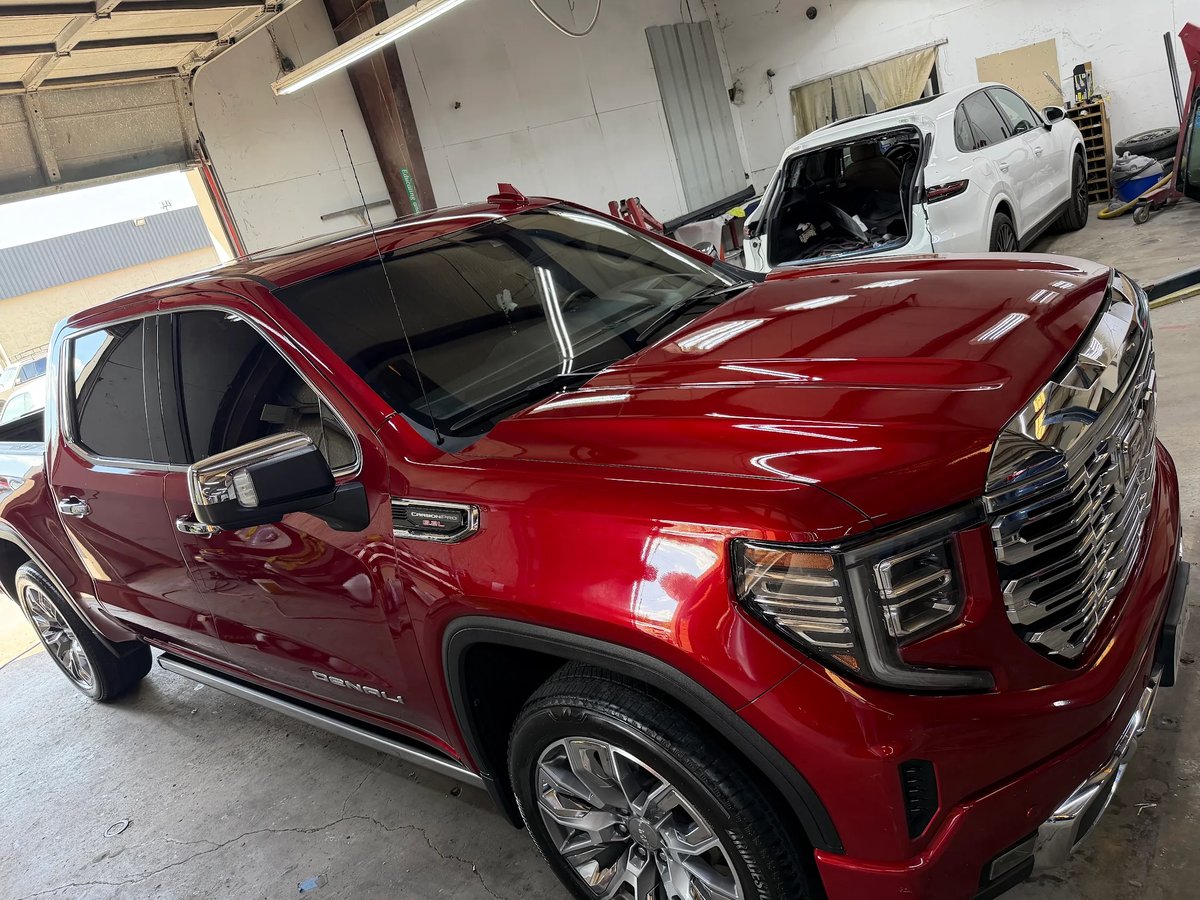
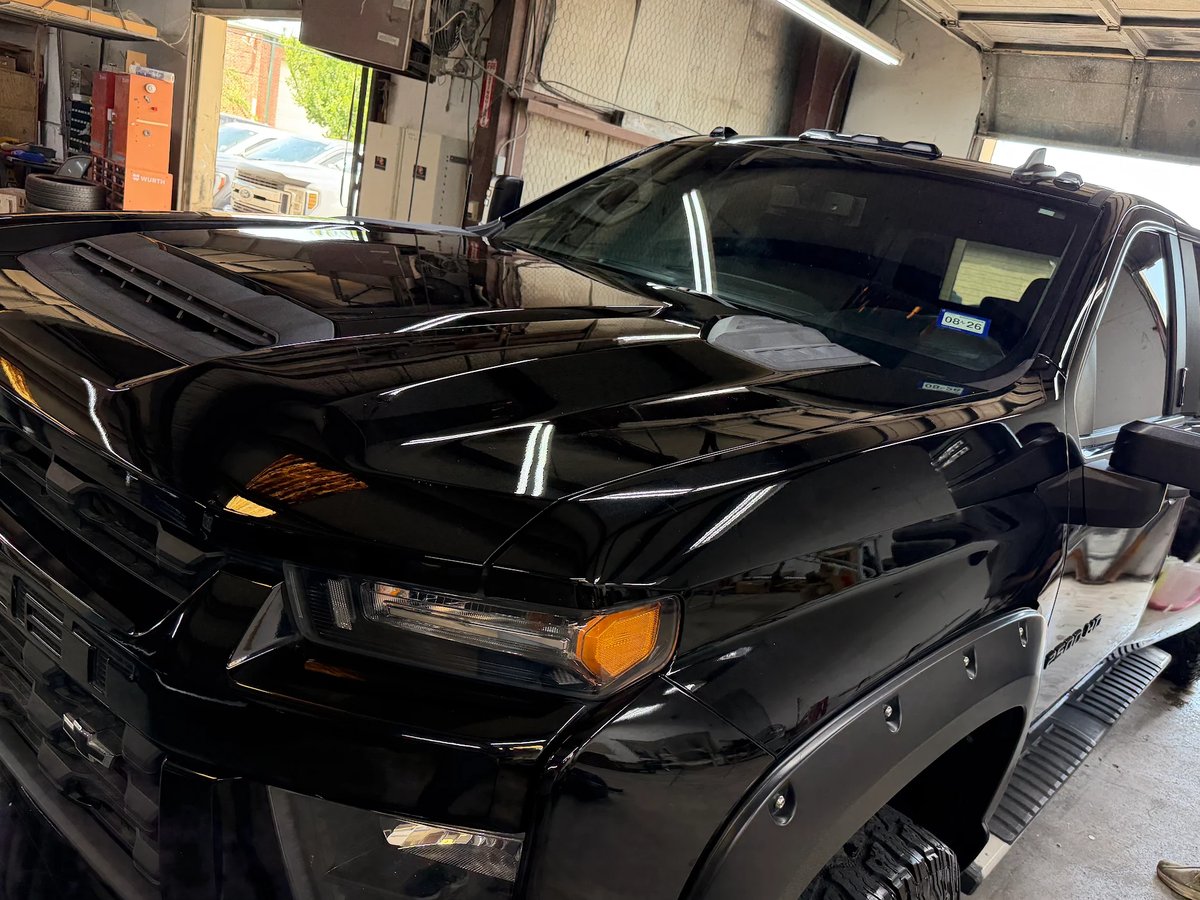
Two real repairs from our Lewisville floor — shown so you can see what heavy hail damage looks like and what proper repair produces. These are shop-floor examples, not photos from the April storms. Drag the sliders.
 Before
After
Before
After
Full-Vehicle Hail — Hood, Roof & Panels
The kind of multi-panel count golf-ball-and-up rounds produce — restored without repainting
 Before
After
Before
After
120-Dent Hood — Marked, Counted, Erased
Every dent circled and counted for the written estimate, then removed with the factory paint intact
April Outbreak Questions