Storm-Chaser Guide · DFW
How Do You Spot A Hail Repair Scam?
By what they ask you to sign, and what they promise about your deductible. A legitimate hail repair starts with a written estimate from a shop that has a Texas street address and will still answer the phone in March. A scam starts with a signature — a work authorization, a “direction to pay,” an assignment of your claim — before any estimate exists, and a promise to make your deductible disappear by padding the bill your insurer pays. That second promise is insurance fraud under Texas Penal Code §35.02, filed under your name. Below: the nine tells we see every storm week in DFW, the law on driveway contracts (you usually have three business days to cancel), how to read a tent estimate against a real one, and what to do if you already signed.
The tells, ranked: a deductible “waived” with no explanation of who actually pays for it; a signature wanted today, before any written estimate; a flat price from the curb with no dent count; a cash deposit; “your insurance company sent us”; no Texas street address; a tent that leaves Friday. One question defeats most of them: where will you be in March? A real shop has a real answer.
The tells, in order of how much they should worry you: a promise to “waive” or “cover” your deductible with no explanation of who pays for it; a signature wanted today, before a written estimate; a flat price quoted from the curb with no dent count; a cash deposit; “your insurance company sent us”; no Texas street address; a tent that leaves Friday; an offer to “handle” or negotiate your claim; and dents that multiply after the tent has had the car. The law you can use: Texas Business & Commerce Code Chapter 601 gives you until midnight of the third business day to cancel most contracts signed in your driveway or at a pop-up location (over $25, solicited away from the seller’s fixed place of business); Insurance Code §1952.301 means no carrier can send you anywhere; Penal Code §35.02 makes the padded-estimate deductible trick fraud; and Insurance Code §4102.163 bars a contractor from adjusting the claim on property it repairs. The honest version of deductible help exists — ours covers the first $1,000 on qualifying hail claims, printed on the estimate, funded from our margin, with a 100% honest invoice to the carrier. Already signed? Cancel in writing within three business days, tell your carrier before the tent does, and report it to TDI at 800-252-3439. General information, not legal advice.
What Shows Up The Week After A DFW Storm
We’ve watched the same week play out after every big storm since 1978, and it played out again after the August 26, 2026 hail in Keller and the Alliance corridor. Within forty-eight hours the tents go up in big-box parking lots along the swath. Trucks with magnet signs and out-of-state plates work the neighborhoods the NWS reports name. Door hangers appear. The pitch is friendly, specific, and fast: we’re doing your neighbor’s car, we work with all the insurance companies, and we’ll take care of your deductible.
Let’s be fair before we’re blunt. Some of the traveling paintless-dent technicians who follow hail are genuinely skilled — PDR is a craft, and a good tech with a light and a rod can do beautiful work in a tent. The problem isn’t the tent. The problem is the structure around the tent: no address to bring the car back to, no warranty you can find in March, an estimate written by someone who will never see your adjuster’s supplement, and a business model that only works if the carrier pays more than the repair was worth. That structure produces the same behaviors every year, and those behaviors are the tells.
The National Insurance Crime Bureau, which tracks post-storm fraud nationally, puts the whole guide in one sentence: “If you didn’t request it, reject it.” We’d only add: request it from someone you can find again. Everything below is how to tell the difference before you sign anything.
Read The Pitch
THE NINE TELLS OF A HAIL REPAIR SCAM
Any one of these deserves a second look. Two together mean walk away. The first one, by itself, means walk away.
1. “We’ll Waive Your Deductible” — With No Explanation Of Who Pays
The deductible is your share of the claim; someone has to absorb it. If the answer is “we build it into the estimate,” the carrier is being billed for repair that isn’t happening, and that is insurance fraud under Texas Penal Code §35.02 — on a claim with your name on it. The honest version is a shop paying it out of its own margin on top of a 100% truthful invoice, and an honest shop will say exactly that, in writing. The full mechanics are below.
2. A Signature Today, Before Any Written Estimate Exists
Work authorizations, “direction to pay” forms, and assignments of your claim proceeds are contracts. Signing one in a parking lot before anyone has counted a dent hands control of your claim to a company you met an hour ago. A real shop’s sequence is estimate first, signature second — and Texas gives you a three-business-day cancellation right on most driveway and pop-up contracts (details below).
3. A Flat Price Quoted From The Curb
“Hoods are $400, roofs are $600.” Hail is priced by counting — dents per panel, by size and depth, under reflected light — plus the trim that has to come off for access. Our published cash rate is $75–$200 per dent plus R&I trim labor when panels or trim come off, and the count is done in the shop, not on the asphalt. A number that arrives before the count did is a number designed to get a signature.
4. A Cash Or Check Deposit Up Front
On an insurance repair the carrier pays the shop, and on a cash repair you pay when the car is finished and you’ve looked at it. A deposit “to hold your spot” or “for materials” on a PDR job — a repair with almost no materials — is the money that leaves town with the tent.
5. “Your Insurance Company Sent Us”
It didn’t. Texas Insurance Code §1952.301 gives the policyholder the choice of shop; a carrier can suggest a network, but it doesn’t dispatch repair crews to driveways. Claiming an affiliation or approval a business doesn’t have is on the Texas Deceptive Trade Practices Act’s own list (Bus. & Com. Code §17.46(b)(5)). If you want to know whether a company is in your carrier’s network, call the number on your card and ask — not the tent.
6. No Texas Street Address You Can Drive To
Texas doesn’t license body shops at the state level, so nobody checks a tent’s credentials before it opens — that check is yours. Ask for the physical address of the shop that stands behind the work, then look at it on a map. A P.O. box, a residential address in another state, or “we’re mobile” all answer the question you actually asked, which is where does my warranty live in March?
7. The Deadline Is Theirs, Not Yours
“The tent leaves Friday.” “Rates go up when the catastrophe adjusters pull out.” “Your carrier only pays for thirty days.” None of that is how a comprehensive hail claim works; most carriers give you a year or more to report, and the repair happens on your schedule. Urgency that comes from the seller’s calendar is a sales technique, not a fact about your claim.
8. “We’ll Handle Your Claim For You”
Negotiating an insurance claim on a policyholder’s behalf for compensation is public adjusting, a licensed profession in Texas (Insurance Code §4102.051) — and §4102.163 says a contractor may not act as a public adjuster, or even advertise to adjust claims, for property it repairs or may repair, license or no license, power of attorney or not. A body shop’s honest job is narrower: you open the claim, the shop documents the damage, writes the supplement, and handles the adjuster correspondence about its own repair. “We’ll deal with your insurance so you don’t have to” is either that ordinary process described with bigger words, or something the tent isn’t allowed to do.
9. The Dents Multiply After They’ve Had The Car
We’ve had cars come to us from tents with more damage than the storm left: creased panels from the wrong tools, cracked paint from glue-pulling on a hot hood, a roof that now needs a body-shop repair instead of PDR. We won’t tell you anyone did it on purpose. We’ll tell you to photograph every panel and get a written dent count before the car leaves your sight, so the count when it comes back can be checked against something.
The Deductible Line: Where Help Becomes Fraud
Almost every hail pitch runs through the deductible, so this is the section to understand. Start by clearing up the law people quote at you. The Texas statute that makes “waiving the deductible” a crime — House Bill 2102 from 2019, now Business & Commerce Code §27.02 — covers real property: roofs and homes. It’s a roofing law, and its fame is why so many people believe deductible help on a car is automatically illegal. It isn’t. Cars are personal property, and the rule that governs them is older and simpler: Penal Code §35.02, insurance fraud. Our deductible guide walks the full framework.
Under §35.02 the question is never whether the deductible was covered but who paid for it. If the shop writes a 100% honest estimate, bills the carrier only for work actually done, and then knocks the deductible off your share out of its own profit, the carrier hasn’t been deceived and nothing illegal happened — that’s a discount. If the shop inflates the dent count, bills panels it never touched, or adds “R&I” lines for trim that stayed on the car so the carrier unknowingly funds your deductible, that’s the crime — and the claim file that documents it carries your name and your signature on the authorization.
So the test for any deductible offer is one question: “Where does the money come from?” The honest answer is specific, printed, and capped, because a shop paying from its own margin knows exactly how much it can afford. Ours is on the deductible assistance page: on qualifying hail claims we cover the first $1,000 of your deductible, printed on the estimate, with a line-item invoice your adjuster can read top to bottom; above $1,000 it’s a case-by-case conversation, and we say so instead of promising the whole thing. A tent answer is vague — “don’t worry about it,” “we work it out with the adjuster” — because the money is coming from a place they’d rather not name.
What You’re Actually Signing — And The Three-Day Rule
The clipboard at the tent usually holds one of three documents, and they’re worth knowing by name. A work authorization lets the company begin repairs — and once repairs begin, cancelling gets expensive and messy. A direction to pay instructs your carrier to send the claim check to the company instead of to you. An assignment of benefits (sometimes buried inside the other two) transfers your rights under the claim to the company, so it can negotiate with and be paid by your carrier as if it were you. Any of these, signed before a written estimate exists, means the tent now controls the money and the schedule and you control neither.
Here is the Texas law most people never hear about. Business & Commerce Code Chapter 601 applies to a consumer purchase over $25 when the seller solicits you somewhere other than its own fixed place of business and you sign there — your driveway, a parking-lot tent, a folding table outside a grocery store (§601.002). For those contracts, you may cancel any time before midnight of the third business day after the day you signed (§601.051). The seller is required to tell you so, in a notice the statute spells out word for word — “YOU, THE BUYER, MAY CANCEL THIS TRANSACTION AT ANY TIME PRIOR TO MIDNIGHT OF THE THIRD BUSINESS DAY AFTER THE DATE OF THIS TRANSACTION” — and to hand you a completed copy of the contract, dated, with its name and address on it, at the moment you sign (§601.052). A contract missing that notice is a tell all by itself.
The limits, honestly stated: the right doesn’t apply if you drove to the seller’s fixed shop and negotiated there (§601.002(b)), it’s a cancellation right, not a refund of finished work you accepted, and business days exclude weekends and holidays. Exercise it in writing — the signed, dated cancellation form the seller was supposed to give you, or your own letter — sent to the address on the contract before the deadline, with a photo of what you sent and proof of when. The estimate-reading guide covers what a legitimate authorization looks like once an honest estimate is in hand. General information; if there’s real money on the line, a consumer attorney reads the paper faster than we do.
Tent Estimate vs. Shop Estimate, Line By Line
A tent estimate is usually one page and looks reassuringly simple. That simplicity is the problem. Here is what each line on a real hail estimate does, and what the tent version leaves out.
The published hail ranges every DG page uses — light 1–2 panel damage $750–$1,500; deep dents on 1–2 panels $1,500–$4,000; several panels with paint intact $3,000–$6,500; a typical full-vehicle carrier claim $5,000–$12,000; severe $7,500–$15,000+ — are in the hail cost guide. A tent quote that comes in far below those ranges isn’t a bargain; it’s a count that hasn’t happened yet.
The March Test (And The Rest Of The Credential Check)
Every hail repair carries a warranty question that only gets answered later: when a dent that was glue-pulled in September reappears in a cold snap, or a roof that looked fine under the tent lights shows every ripple in low winter sun, who fixes it? So the single most useful question you can ask any hail repair company is “Where will you be in March?” Not “do you have a warranty” — everyone says yes — but where, physically, a person will be standing when you need to use it. Our answer is 693 Metro Park Circle in Lewisville, where it has been since 1978, and our warranty is lifetime on everything except mechanical work.
The rest of the check takes one evening. Because Texas has no state license for body shops, the credentials that mean something are the ones a shop earns and you can verify: I-CAR Gold Class is a shop-wide training designation you can look up on I-CAR’s own site; a BBB profile shows how long a company has existed and how it handles complaints; Google reviews tell you more by their dates than their stars — a hundred five-star reviews all posted the week after a storm tell one story, reviews spread across years tell another. Then run the ten questions in our choose-a-shop guide, which take a single phone call. A company that passes the March test and the credential check can absolutely be a traveling PDR outfit; the point isn’t the tent, it’s whether you can find them again.
Already Signed? Already Paid? Here’s The Order Of Operations
First, the clock. If you signed in your driveway or at a tent within the last three business days, cancel now, in writing, to the address on the contract, and keep proof — that’s the Chapter 601 right above, and it doesn’t require a reason. If the contract has no cancellation notice or no seller address on it, write to whatever address and email you have and photograph the attempt; the missing notice is itself a problem for the seller, not for you.
Second, your carrier. Call the claims line yourself and tell them what you signed and with whom, before the company submits anything under your claim number. Make clear that you are choosing your own shop under §1952.301 and that no direction to pay or assignment should be honored without your written confirmation. If money has already been paid to the company, ask what the carrier needs from you in writing to redirect the claim.
Third, the money. A deposit paid by check can sometimes be stopped if the check hasn’t cleared; a card payment can be disputed with the issuer, and the cancellation notice you just sent is the document the dispute needs. Fourth, the record. Report it — whether or not you get your money back, the report is what lets the next person be warned. The Texas Department of Insurance takes fraud reports at 800-252-3439 and through the NAIC online form it links from tdi.texas.gov/fraud; misrepresentation and pressure tactics also fall under the Texas Deceptive Trade Practices Act, enforced through the Attorney General’s consumer complaint process; and the National Insurance Crime Bureau takes tips at 800-447-6282. Fifth, the car. Before anyone else touches it, get a written dent count and photos from a shop with an address, so whatever happens next is measured against a document rather than a memory.
The Process
VET A HAIL REPAIR OFFER IN FIVE STEPS
Run these in order, before a pen touches paper. They take an afternoon and they work on any company — including us.
Count Before You Sign
Photograph every panel in low-angle light the day you find the damage, then get a free written dent count from a shop under proper lighting. Nothing else in this process works without a number to compare against — and a count in hand is what makes a curb quote instantly readable.
Get Three Things In Writing
The itemized estimate, the warranty with the address of the building that honors it, and any deductible assistance stated as a specific amount with a specific source. A company that can’t produce all three on paper has told you what you need to know.
Run The March Test And The Credential Check
Ask where the company will be in March and look the address up on a map. Verify I-CAR Gold Class on I-CAR’s site, read the BBB profile, and read Google reviews by date, not stars. Texas won’t run this check for you — there is no state license for body shops.
Open The Claim Yourself
Call your carrier’s claims line or use its app, give the storm date, and take the claim number. Under Insurance Code §1952.301 the shop is your choice; nobody “handles” your claim for you, and a company that wants to file it on your behalf is asking for control it shouldn’t have.
Read Every Page, Then Remember The Three Days
Know whether you’re signing a work authorization, a direction to pay, or an assignment of your claim, and sign nothing before the estimate exists. If it’s a driveway or tent contract, Business & Commerce Code Chapter 601 gives you until midnight of the third business day to cancel in writing — and the contract must say so.
From Our Floor
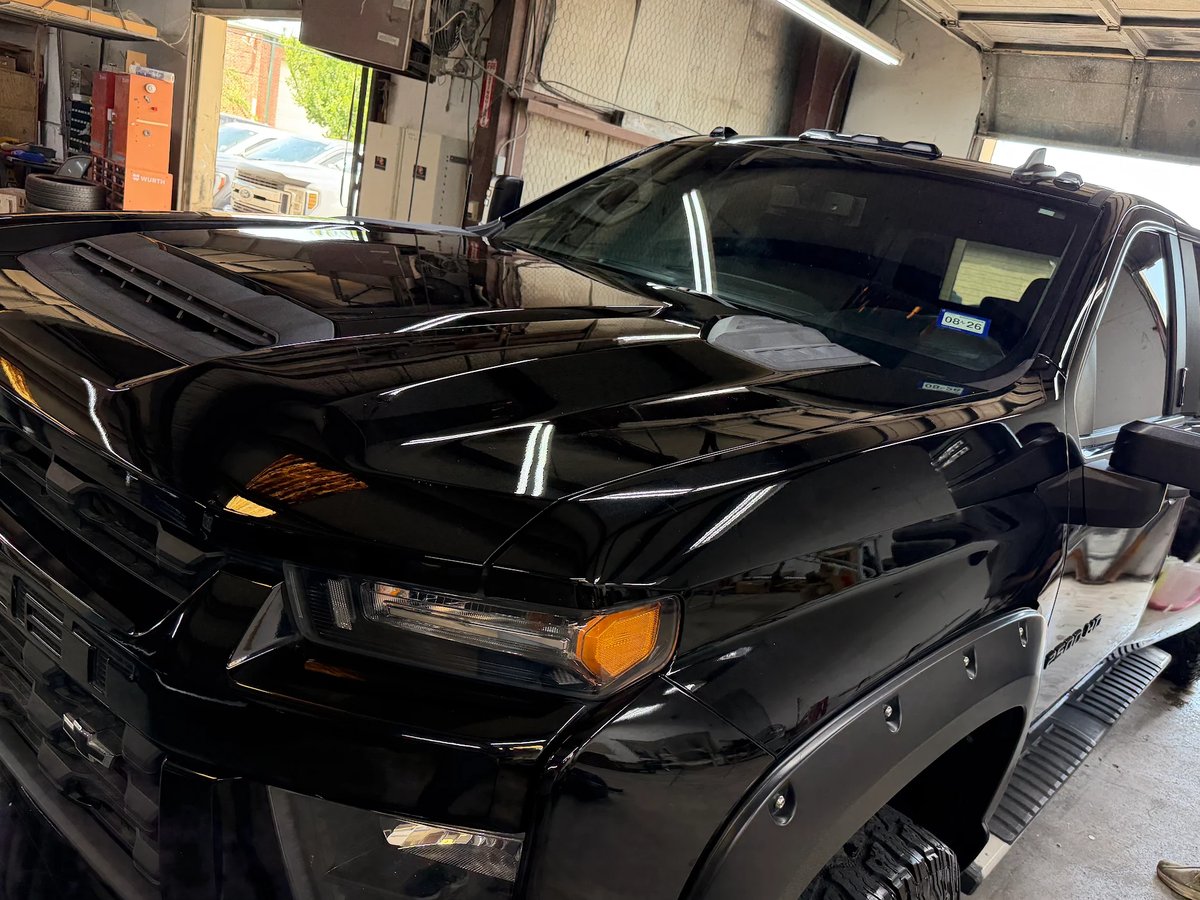
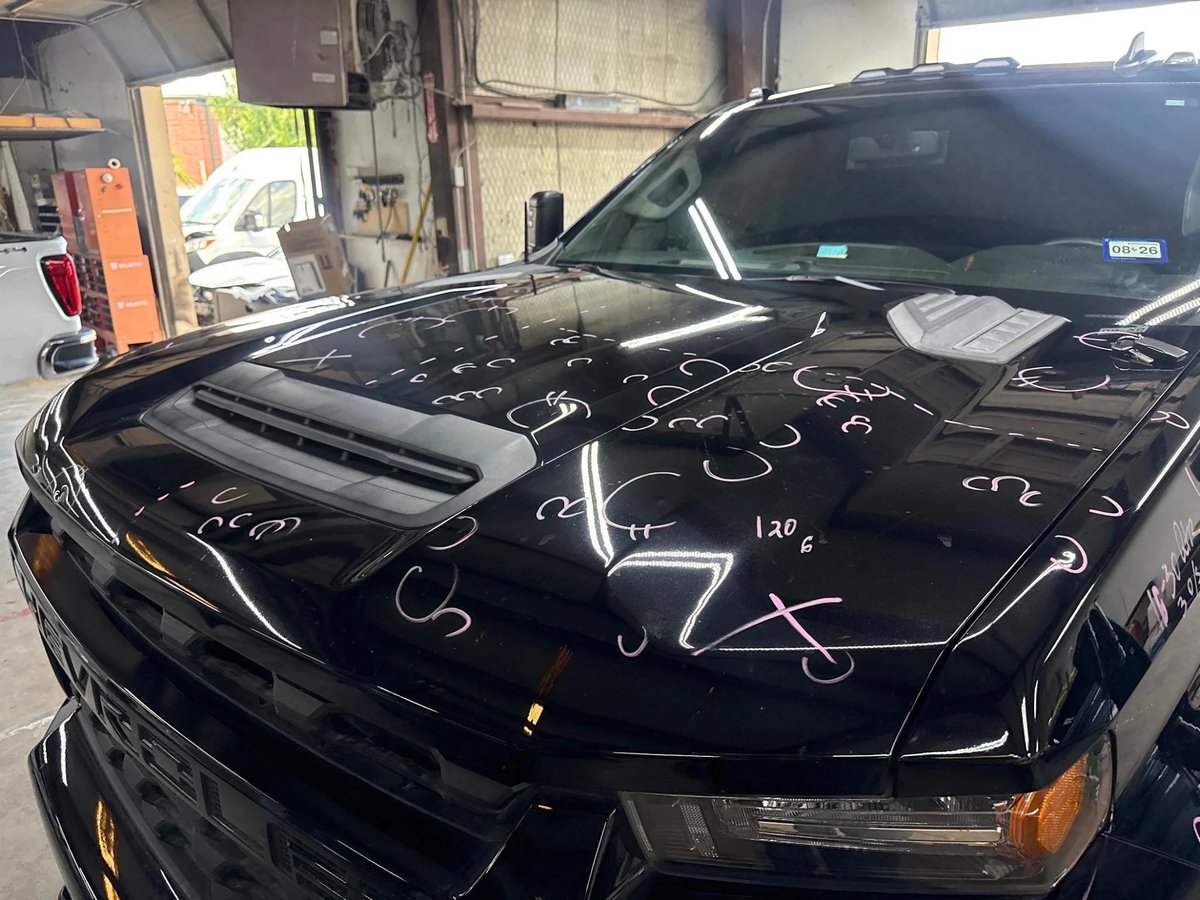
WHAT A REAL COUNT LOOKS LIKE
Drag the slider. Every dent marked before the estimate was written — the document a curb quote never produces.
 Before
After
Before
After
120 Dents, Counted And Marked Before The Estimate
Pictured: a customer’s pickup hood on our Lewisville floor — every hail dent marked under reflected light and counted (120 on this hood) before a single line was written, then repaired without repaint. The marks are the estimate; a curb quote skips them.
Got A Tent Quote? Get A Second Count, Free.
Text photos of the damage and the paper they handed you. You’ll get an honest read on the count, the price against the published ranges, and whether anything on that clipboard should worry you — in writing, from a shop that has been at the same Lewisville address since 1978.
Common Questions
HAIL REPAIR SCAM FAQ
Statutes cited: Tex. Bus. & Com. Code Ch. 601 (§§601.002, 601.051, 601.052), §27.02, §17.46; Tex. Penal Code §35.02; Tex. Ins. Code §§1952.301, 4102.051, 4102.163 — verified August 2026 against the Texas statutes. Written from our own experience on the shop floor after DFW hail events since 1978. General information — not legal advice; consult a consumer attorney about a specific contract.
Free · No Obligation
GET A REAL COUNT BEFORE YOU SIGN
Tell us what you drive and what the storm did. We’ll come back with a written estimate — so you can make the file-or-skip call with the real number in hand.
Prefer to talk now? Call (972) 219-0864 · or text us photos