YOUR AIRBAGS DEPLOYED — IS THE CAR TOTALED?
Not automatically. No Texas law totals a car because its airbags fired — total loss is pure math: repair cost against the car’s actual cash value. What deployment really does is add expensive, non-negotiable lines to the estimate — airbags are single-use, and the pretensioners, module, and sensors around them follow OEM replacement procedures. On a newer car that math usually says repair; on an older one it can tip the scale.
No — deployment doesn’t total a car by itself. Texas totals on arithmetic: repair cost (excluding repaint materials and sales tax) reaching 100% of the car’s actual cash value. Airbags fire at forces many very repairable cars see — NHTSA puts frontal deployment at fixed-barrier equivalents of just 8–14 mph — but they do add expensive, single-use, always-genuine line items, which is why deployment tips older, lower-value cars over the line while newer cars repair routinely.
Airbag deployment doesn’t total a car by itself — no Texas statute says so, and NHTSA notes frontal airbags are designed to fire in crashes equivalent to hitting a fixed barrier at just 8–14 mph, forces many very repairable cars see. What decides total loss is math: Texas’s salvage statute uses a 100% formula — repair cost (excluding repaint materials and sales tax) exceeding the car’s actual cash value — and insurers often make the economic call earlier, once repairs approach ACV. Deployment does guarantee expensive line items: airbags are single-use per NHTSA and must be replaced — never reset, never reused — along with fired seat-belt pretensioners, usually the restraint control module per the manufacturer’s procedure, and often the steering wheel when the driver’s bag fires; ADAS recalibration typically follows. One hard warning: counterfeit replacement airbags are a real, documented killer — NHTSA ties ten deaths to one illegally imported inflator type — and installing one is a felony in Texas. OEM restraint parts, from a shop you chose, are the only version of this repair worth doing.
- Deployment ≠ totaled: the decision is repair-cost-vs-ACV math, not the airbags themselves.
- Single-use by design: deployed bags, fired pretensioners, and usually the control module get replaced per OEM procedure — there is no legitimate “reset” shortcut for a deployed bag.
- Counterfeit airbags kill: NHTSA documents deaths in otherwise-survivable crashes; installing one is a Texas felony (Transp. Code §547.614).
- If it totals: the ACV number is negotiable, and keeping the car has real salvage trade-offs — run the math before signing.
The Rule, Minus The Myth
DEPLOYMENT ISN’T A VERDICT — THE MATH IS
The airbags-equals-totaled belief survives because deployed bags look like a verdict — the cabin full of powder, the dash torn open. But deployment is a sensor decision, not a damage assessment: NHTSA’s published threshold is that frontal airbags “are generally designed to deploy in ‘moderate to severe’ frontal or near-frontal crashes, which are defined as crashes that are equivalent to hitting a solid, fixed barrier at 8 to 14 mph or higher.” Plenty of crashes at those forces leave a car with a crushed bumper, a bent hood, fired bags — and a thoroughly repairable structure underneath.
What actually totals a car in Texas is arithmetic. The state’s salvage statute draws the line where the cost of repairs — parts and labor, excluding repaint materials and sales tax — exceeds the vehicle’s actual cash value immediately before the damage (Transp. Code §501.091), the “100% formula” you’ll hear cited. In practice insurers often make the economic call earlier: TDI’s consumer guidance says a company will likely consider the car totaled when repair costs are “about the same or more than the car’s value.” Notice what’s missing from both versions: any mention of airbags. Deployment’s real role is financial — it adds several non-negotiable four-figure line items to the estimate, which shoves the repair total toward ACV faster on an older car than a newer one. A $9,000 restraint-and-bodywork estimate is a repair on a $30,000 SUV and a total on an $8,000 sedan; same crash, different math. The full total-loss playbook — how ACV gets set, disputing a low offer, keep-or-surrender — lives in our total-loss guide; this page covers the airbag-specific half.
The Non-Negotiable Line Items
EVERYTHING A DEPLOYMENT ACTUALLY REPLACES
Airbags are single-use by design. NHTSA’s guidance is unambiguous: “air bags can only deploy once, so make sure you replace used air bags right away after a crash, only at an authorized repair center, and before you drive the vehicle again” — and its FAQ closes the reset fantasy explicitly: a deployed bag “cannot be re-used and must be replaced.” The bag is only the visible piece. Fired seat-belt pretensioners are spent the same way — Nissan’s published position statement calls for replacing the pretensioner “even if the seat belts are not in use during a collision in which the frontal air bags are deployed,” and belts that were being worn in the crash get inspected or replaced across OEM procedures. The restraint control module that commanded the deployment typically gets replaced too — or reset only where the manufacturer’s own procedure allows it; Tesla’s repair procedures, to take one published example, require a new module, new pretensioner assemblies, and a new steering wheel whenever the driver’s front bag fires. Add impact sensors near the crush zone, the torn dash and trim panels, and — on anything with driver-assist features — recalibration: I-CAR’s guidance is that an ADAS-equipped vehicle in a collision “will more than likely” need calibration to the OEM’s spec.
Why we’re listing this so completely: an estimate that skips these lines isn’t cheaper, it’s dishonest. A deployment repair quoted without pretensioners, module, and calibration is either a shop that doesn’t know restraint systems or one hoping you won’t ask — and the difference surfaces in the worst possible way, in the next crash. Reading those line items is a skill worth five minutes: our estimate-reading guide shows you exactly what R&R on an SRS component should look like on paper, and our calibration page covers what happens after the metalwork.
BAGS DOWN, DASH OPEN? GET THE COMPLETE ESTIMATE.
Free written estimate with every SRS line item on paper — bags, pretensioners, module, calibration — so the repair-or-total math is real.
The Scam With A Body Count
THE COUNTERFEIT-AIRBAG TRAP — REFUSE IT BY NAME
Because deployment repairs are expensive, a gray market exists to make them cheap — and it is the single most dangerous corner of collision repair. NHTSA’s testing found counterfeit airbags “consistently malfunction in ways that range from non-deployment to the expulsion of metal shrapnel during deployment,” and its current alert on illegally imported replacement inflators counts ten deaths and three severe injuries in thirteen crashes — in the agency’s words, fatalities “in crashes that should have been survivable.” Texas treats the scam accordingly: knowingly installing a counterfeit airbag — or charging for an airbag and installing nothing — is a felony under Transp. Code §547.614, escalating to a first-degree felony if someone dies.
Your defenses are boring and effective. First, choose the shop yourself — Texas Ins. Code §1952.301 makes that your call, not the insurer’s, and a shop’s answer to “where do your replacement airbags come from?” should be one word: OEM. (Ours is. Restraint components are the one category where the OEM-vs-aftermarket debate has exactly one defensible side, and we put the sourcing on the invoice.) Second, if a quote for deployment repair comes in shockingly below everyone else’s, treat the discount as the warning label it is — the parts being skipped or faked are the ones between your chest and the steering column. And if you’re shopping used: NHTSA’s own advice is to check the history report for airbag deployments and prior total-loss events, then verify the bags actually present — a task any honest shop can do in an hour.
When The Numbers Fall The Other Way
IF THE MATH SAYS TOTAL
Sometimes the math is honest and the car is done — a deployment repair plus structural work on a high-mileage sedan can clear ACV with room to spare. Three things to know before you sign anything. The ACV number is negotiable: TDI’s guidance says it directly — if you think your car is worth more than the offer, “you can try to negotiate” — and comparable local listings, your options and condition, and recent maintenance records are the currency that moves it. Keeping the car is a real choice with real costs: the insurer subtracts the salvage value from your payout, and a collision-totaled car goes through Texas salvage-title steps — TxDMV’s process requires the rebuilt vehicle to pass inspection before it drives again, and a branded title cuts resale value and insurability. And the check may not be all yours: on a financed car the lienholder gets paid first — the payoff math, GAP coverage, and the underwater scenario are covered in our leased-and-financed guide.
One quiet upside worth knowing: a totaled car doesn’t end your claim rights. Loss of use — the rental-value of the weeks you’re carless — survives a total loss in Texas when another driver caused it, and the deadline mechanics on suing an at-fault driver run two years. If the crash wasn’t your fault, the not-at-fault guide walks the full list of what the other side owes on top of the ACV check.
The Playbook
AIRBAGS DEPLOYED — 5 STEPS
01. Don’t drive it
NHTSA’s rule: replace deployed bags before the vehicle is driven again. A car with spent airbags has no restraint protection left for the next impact — tow it, don’t limp it.
02. Send it to a shop you chose
Texas law puts the shop choice with you, not the carrier. For restraint work specifically, choose on parts sourcing and documentation, not on the cheapest quote in town.
03. Demand the full SRS line-items
Bags, fired pretensioners, control module per OEM procedure, impact sensors, calibration. An estimate missing any of them isn’t a bargain — it’s an incomplete repair priced to look like one.
04. Run the total-loss math yourself
Complete estimate on one side, realistic ACV on the other — comparable listings, your trim and mileage. Knowing which side of 100% you’re on turns the adjuster’s call into a conversation.
05. Negotiate before you sign
Low ACV offers move when met with comps and records — TDI says so itself. If it totals, decide keep-versus-surrender with the salvage deduction and title consequences priced in, not discovered later.
From Our Shop Floor
THE FRONT-END CLASS OF HIT THAT ASKS THE QUESTION
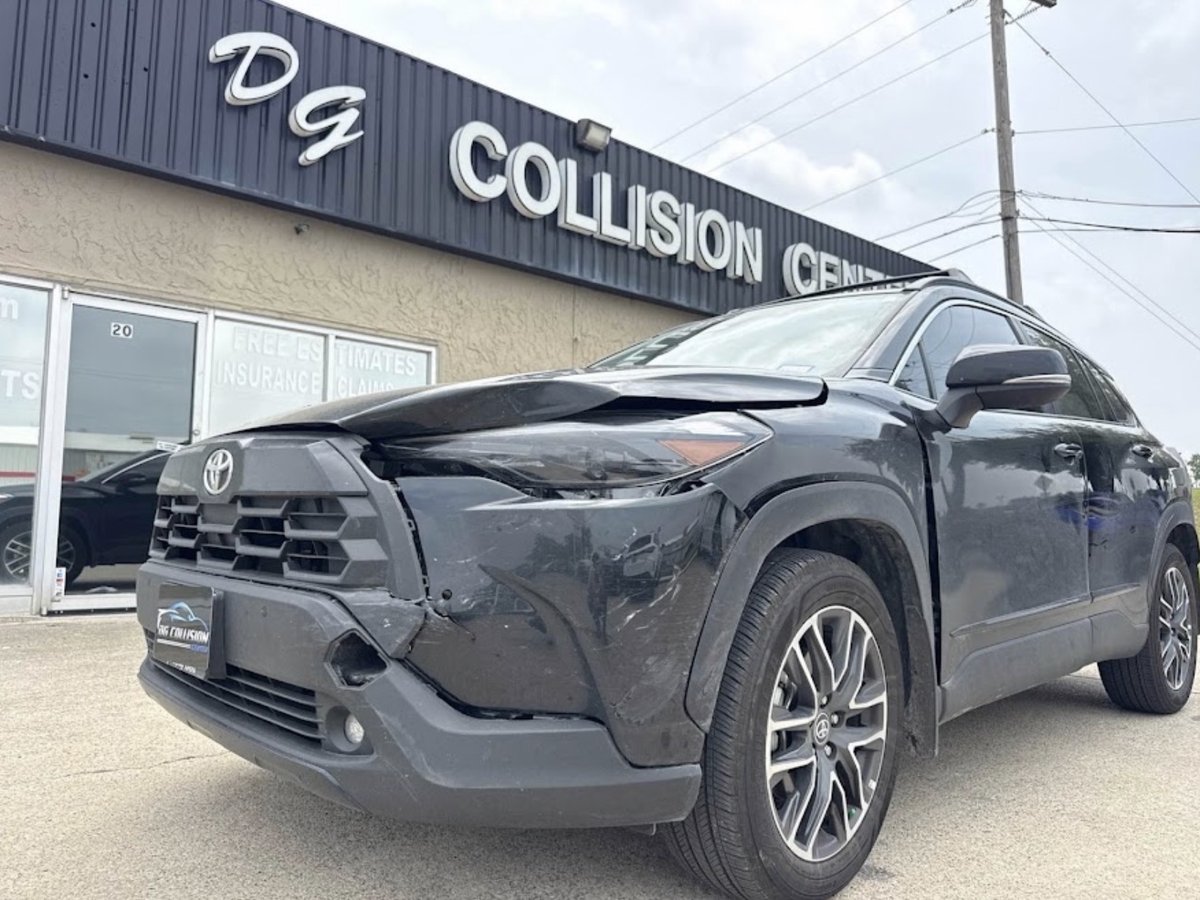
Drag the slider — a real front-end rebuild from our Lewisville floor, the frontal-impact class where the repair-or-total question gets decided.
 Before
After
Before
After
Front-End Hit — Bumper, Grille & Hood
Pictured: Toyota RAV4 — front-end rebuild repaired and color-matched on our Lewisville floor; the same class of frontal hit where airbag decisions get made
Airbag-Deployment Questions