YOUR CAR WAS HIT WHILE PARKED — NOW WHAT?
Start with the windshield. If the driver left a note — Texas law requires one, with their name, address, and what happened — you claim against their liability insurance and pay no deductible at all. No note? That’s a hit-and-run on a parked car: hunt cameras the same day, file a police report, and the repair runs through your UMPD coverage ($250 deductible, fixed by statute) or your collision coverage.
Look for a note first — Texas law (Transp. Code §550.024) required the driver to stop and leave their name, address and what happened; driving off is a misdemeanor at essentially any visible dent. Note in hand: file on their liability, no deductible. No note: treat it as a hit-and-run — photograph everything, ask nearby businesses for camera footage the same day, and file the police report even in a private lot.
A driver who hits a parked car in Texas must stop and either find you or leave a written notice with their name, address, and a statement of what happened — Tex. Transp. Code §550.024. Driving off instead is a Class B misdemeanor once damage passes $200, which is essentially any visible dent. If you have a note, file against the driver’s liability insurance: no deductible, they pay. If you don’t, treat it as a hit-and-run — photograph everything, ask nearby businesses for camera footage the same day, file a police report even in a private lot, and run the repair through UMPD (statutory $250 deductible, Tex. Ins. Code §1952.105) or your collision coverage. For small damage, get a written estimate before filing anything — a $400 scuff repair isn’t worth a claim against a $500 deductible.
- Note left: their insurance pays, you owe no deductible — the note law requires name, address, and circumstances.
- No note: cameras + police report, then UMPD ($250 by statute) or collision coverage.
- Police in private lots: officers often aren’t required to work them — file the report anyway; UM claims need it.
- Small dents: published repair ranges start at $300–$800 — get the number first, then decide claim vs cash.
The Good Scenario
THERE’S A NOTE ON THE WINDSHIELD
Texas is specific about what that note owes you. Under Tex. Transp. Code §550.024, a driver who strikes an unattended vehicle must stop and either find the owner in person or leave — conspicuously placed or securely attached — a written notice with the name and address of the driver and the vehicle’s owner, plus a statement of the circumstances. Notice what’s not on that list: the law doesn’t require a phone number or insurance details. So a scrawled number with no name is the driver doing less than the law asks — and a full note is someone doing it right, which tells you something about how the claim will go.
Before you touch the note, photograph it where it sits. Then photograph your car in place: the damage, the position in the space, the paint left behind by the other bumper, any debris on the ground. Then call the number or carrier — you’re opening a third-party claim against the driver’s liability insurance, which means no deductible comes out of your pocket at any point. The full third-party playbook — what their carrier owes, how the liability investigation runs, what to do when it stalls — is in our not-at-fault claim guide; the short version is that you hand the note and photos to their insurer, get a written estimate, and let the shop bill the carrier direct.
One caution from the claims side of our counter: a note is not an admission their insurer is bound by. Adjusters still verify their customer actually hit you — which is exactly why the photos of paint transfer and position matter more than the note itself. Take them before the car moves.
The Common Scenario
NO NOTE — A HIT-AND-RUN ON A PARKED CAR
Most parked-car damage comes with no note at all, and then the clock matters. Cameras first, same day: storefront cameras at the shopping center, apartment and HOA cameras at the complex, doorbell cameras on a residential street, and the dashcams of cars parked around you — many record while parked. Retail camera systems overwrite on cycles as short as a few days, so ask the manager today, not after the insurance call. Note the exact space you were in and the time window; footage requests go faster when you can say “row three, between 2 and 5 pm.”
Then file a police report — even in a private lot. Here’s the honest version of how that goes: Texas law doesn’t require officers to investigate collisions in privately owned parking areas (§550.041(b) carves them out), so in much of DFW an officer may take a counter report or point you to an online portal rather than come out. File it anyway. The Texas Department of Insurance is blunt about why: uninsured motorist coverage won’t pay a hit-and-run claim that was never reported to police. There’s no statutory deadline on that report, but every day of delay reads as a red flag to an adjuster — report promptly and the paper trail works for you. (The old CR-2 “blue form” driver’s report was retired at the state level back in 2017, so don’t chase one — the police report is the document that counts.)
If the footage or a witness identifies the driver, everything upgrades: the claim moves to their liability carrier and their leaving becomes a criminal matter — the full what-happens-next is in our hit-and-run guide. If nobody surfaces, the next section is your map.
FOUND DAMAGE IN A PARKING LOT? GET THE NUMBER FIRST.
A free written estimate tells you whether this is a claim or a cash fix — before you call any insurance company.
Follow The Money
WHO PAYS FOR A PARKED-CAR HIT IN EACH SCENARIO
Two notes on that table. UMPD is the quiet winner for parked-car hit-and-runs — the $250 deductible is set by statute and usually beats a collision deductible by hundreds; TDI makes the same point in its own hit-and-run guidance. And if you end up filing on collision because the driver was never found, know that there’s no subrogation target for your carrier to chase — the deductible-refund machinery from our deductible-back guide needs an identified at-fault driver to work, which is one more reason the same-day camera hunt is worth an hour of your time.
The Honest Math
IS A PARKING-LOT DENT WORTH A CLAIM AT ALL?
Parking-lot damage lives at the bottom of the repair-cost scale, which is exactly where claims stop making sense. Our published collision ranges put minor dents and scratches at $300–$800 and a bumper replacement with paint at $1,000–$2,500 (both from our collision repair page’s cost table). Against a $500 collision deductible, a $400 scuff repair is a cash fix, full stop — you’d pay the whole thing either way and add a claim to your file for nothing. A caved-in door or quarter panel is different money — fender and door work runs $1,500–$3,800 published — and that’s where coverage earns its keep.
The decision framework — when a claim is obviously right, when cash is obviously right, and the gray zone between — is the whole subject of our file-or-pay guide, and our repair cost estimator will put a published range on your damage in about a minute. Or skip both and send us photos — the written estimate is free, and it’s the number every other decision hangs on. One warning before you settle on “it’s just cosmetic”: bumpers hide crushed absorbers and bent brackets behind an intact-looking cover, so a $300 guess can be a $1,300 reality. Get eyes on it before you decline to care.
The Playbook
HIT WHILE PARKED — THE 5-STEP PLAYBOOK
01. Photograph before anything moves
The note where it sits, the damage, your car’s position in the space, paint transfer, debris on the ground. Position photos are what let an adjuster reconstruct the hit you didn’t see.
02. Hunt cameras the same day
Storefronts, apartment offices, doorbells, neighboring dashcams. Retail systems overwrite in days — ask managers today with the exact space and time window.
03. File the police report
Even in a private lot where officers may not respond — take the counter or online report. UM coverage requires a police report on hit-and-run claims, and prompt beats perfect.
04. Pick the payer deliberately
Identified driver: their liability carrier, no deductible. Unknown driver: UMPD at $250 by statute, or collision at your normal deductible. Small damage: get the estimate before filing anything.
05. Repair with documentation
A written line-item estimate, photos before teardown, and a clean invoice — the file that supports whichever claim you opened, and the one that surfaces hidden damage before it’s painted over.
From Our Shop Floor
WHAT A REAR IMPACT REALLY DOES
Drag the slider — a real repair from our Lewisville floor, the same rebuild we run when a parked car takes a bumper instead of a shopping cart.
 Before
After
Before
After
Side Scrape — The Parking-Lot Classic
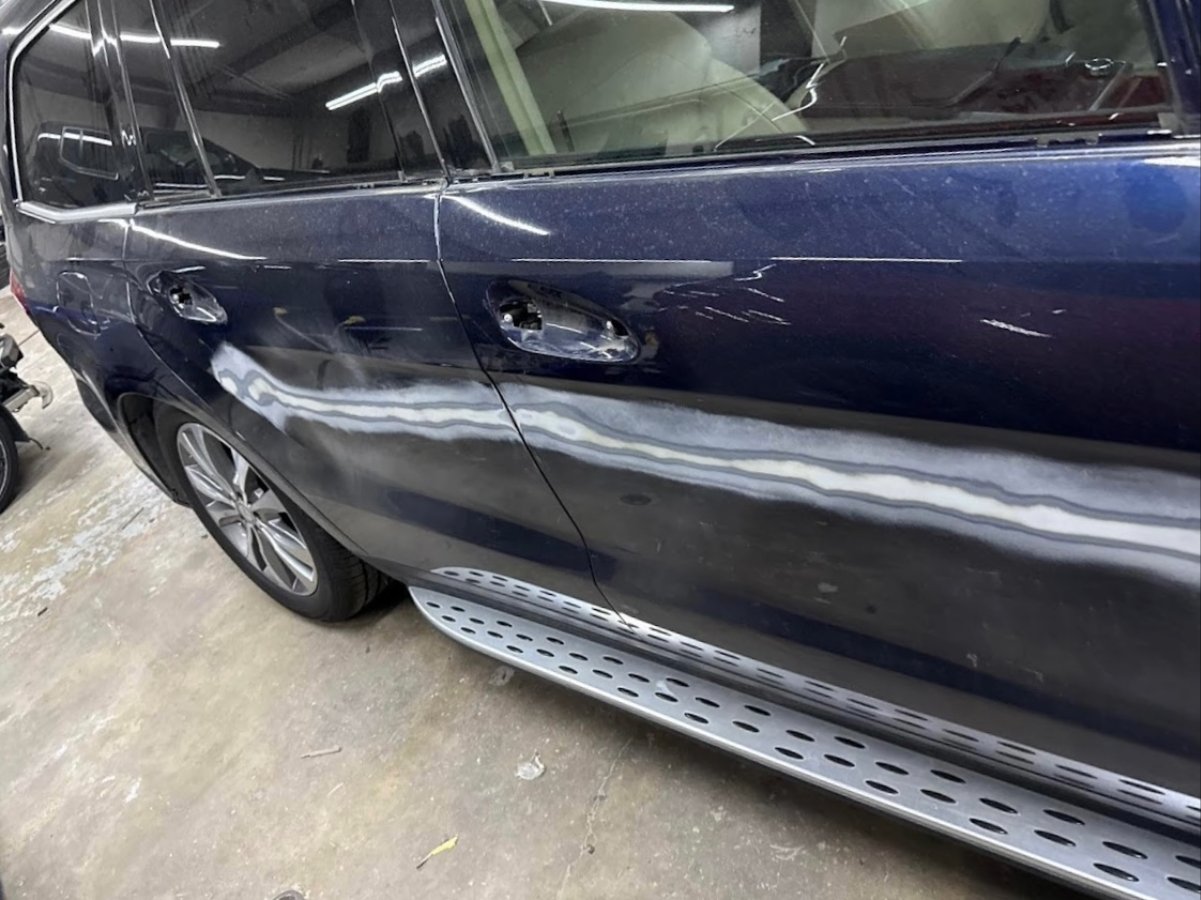
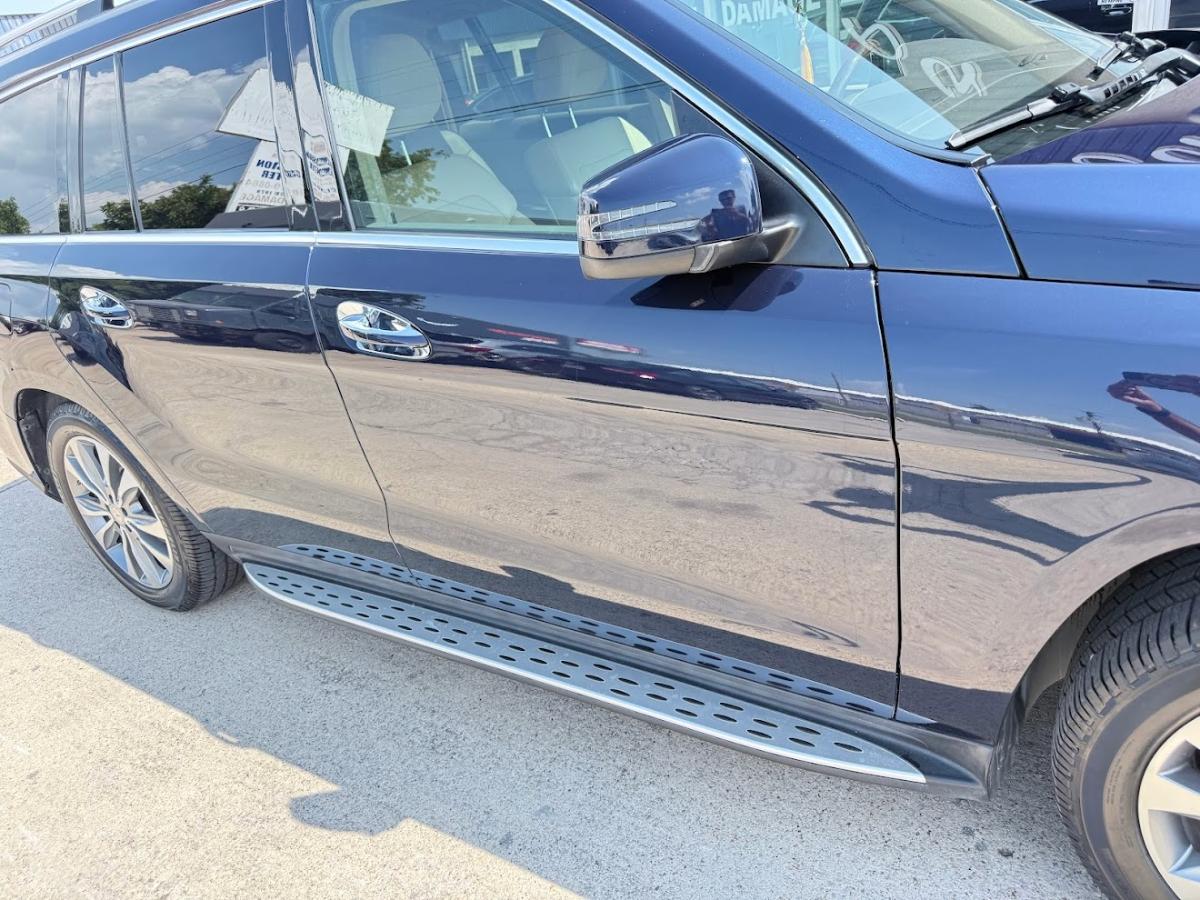
Pictured: a customer’s Mercedes-Benz GLS — the long door scrape a parking-lot hit leaves, refinished to factory match
Parked-Car Questions