STATE FARM CLAIMS IN 2026 — WHAT 90 CARS TAUGHT US
Since January, ninety State Farm-insured vehicles have crossed our Lewisville floor — 38 collision, 52 hail. We kept score: approvals in about five business days, at least one supplement on every single claim, and photo-app opening estimates that covered roughly 20–30% of the final documented repair.
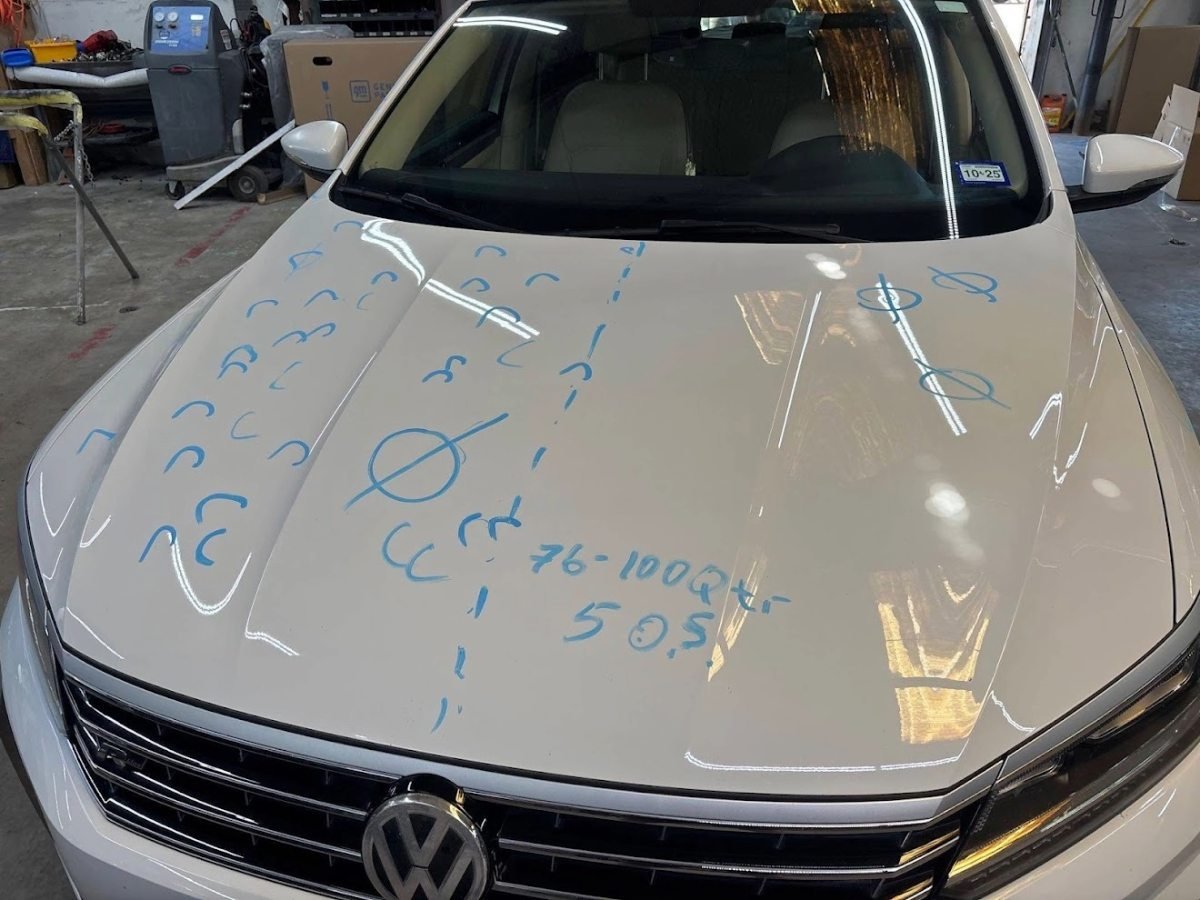
Across ninety State Farm claims repaired at our Lewisville shop since January 2026 — 38 collision, 52 hail — approvals ran about five business days for collision and five to seven for hail once fully documented. Every one of the ninety needed at least one supplement, and supplements cleared in about five business days. Photo-app opening estimates on these cars typically covered 20–30% of the final documented repair: a 2023 Tesla Model 3 opened at roughly $5,000 and closed above $17,000 after four supplements; a 2019 Toyota RAV4 hail claim opened near $4,000 and closed above $14,000. State Farm wrote 18.2% of Texas personal-auto premium in 2024 — second-largest in the state — so the odds your next claim is one of these are real. Texas Insurance Code §1952.301 and State Farm’s own claims page put the shop choice with you — expect Select Service to be suggested more than once on the claim line, but in our files it stayed a suggestion, and the customer’s choice held, all ninety times. We’re independent, we bill State Farm directly, and everything starts with your claim number.
- The sample: 90 claims since January 2026 — 38 collision, 52 hail. One shop’s ledger, not a study.
- The clock: ~5 business days to approve collision, 5–7 for hail, ~5 for supplements.
- The supplement rate: 100% — every claim needed at least one once the car was properly torn down or put under the lights.
- The photo gap: app estimates ran roughly 20–30% of the final documented cost on cars that needed shop-level repair.
- Your rights: the shop choice is yours — Tex. Ins. Code §1952.301, echoed by State Farm’s own claims page — and it held in all ninety of our files, however persistently Select Service came up first.
Report, Not Rating
WHAT THIS REPORT IS — AND ISN’T
Most of what you can read about State Farm claims was written by people who don’t fix cars. This page is the other kind: I run this shop, and since January we’ve repaired ninety State Farm-insured vehicles — 38 collision jobs and 52 hail jobs. Those files have dates on them: when we submitted, when the approval landed, how many supplements it took, what the opening estimate said versus what the finished repair cost. This report is those dates, added up. Data window: January 1 – August 7, 2026. We’ll re-run the numbers quarterly, and the review date at the top of this page moves when we do.
Two honest disclosures before the numbers. First, ninety claims is one shop’s ledger, not a scientific study — the sample sizes stay in the copy so you can weigh them yourself. Second, this is not a rating of State Farm, and none of it is official State Farm information. They’re the second-largest personal auto insurer in Texas — 18.2% of private-passenger premium in TDI’s 2024 market data, just behind Progressive’s 21.1% — which means a huge share of the cars in any DFW body shop are State Farm cars. That’s exactly why the record is worth publishing: if you’re insured with them, the process below is statistically likely to be your process someday. What we observed, on the whole, is a carrier that pays for what gets documented — and an app whose opening number is nowhere near the end of the story.
The companion report for the state’s largest carrier is now live too: our 2026 Progressive shop-floor report — 119 claims, a two-day approval clock, and the shop-vs-photo estimate contrast run at scale.
The Clock, Measured
THE TIMELINE WE ACTUALLY SEE
The hail line deserves a sentence, because 52 of the ninety were hail. What separates a five-day hail approval from a three-week one, in our experience, is the submission itself: a car photographed panel by panel under proper lighting, every dent counted and mapped, arrives at the adjuster’s desk as a decision instead of a question. We’ve built our submissions that way all season — it’s the same discipline behind our hail repair process — and the approvals have followed. Parts rarely add wait: our distributor and dealership relationships put most orders on the dock the next morning, and when something genuinely is on national backorder, we know who to call to move it up the list rather than letting your car hold a stall for a month.
The Opening Number
THE PHOTO ESTIMATE VS THE FINAL BILL
State Farm’s app-based Photo Estimate tool is honest about what it is — their claims page describes it as an initial estimate, delivered fast, with a payout that can arrive within 48 hours. The part policyholders miss is what “initial” means in practice. In our 2026 files, when a car with a photo-app estimate went on to need shop-level repair, that opening number typically covered 20 to 30 percent of the final documented cost. Two cars from our own floor tell it better than any percentage:
Neither of those gaps was a fight. They were documentation: teardown photos, factory repair procedures, scan reports, dent maps — submitted, reviewed, and paid through the supplement process State Farm itself provides for exactly this. Their claims page says it plainly: when a shop finds additional damage related to the claim, State Farm works directly with the shop to review it and pay what’s owed. One honesty note on the percentage: cars whose photo estimate really did cover everything never come to a body shop, so our files only see the ones that needed more. That’s the point — if your car ends up needing real repair, the app number is the beginning of the conversation, not the end of it. Before you cash a photo payout and call it settled, it’s worth understanding how to read the estimate you were handed.
GOT A PHOTO-APP NUMBER THAT FEELS LIGHT? PUT IT UNDER OUR LIGHTS.
The written estimate is free. If there’s more damage than the app saw, we document it and file the supplement with State Farm ourselves — that’s the process working, not a fight starting.
Why Every Claim Grew
SUPPLEMENTS — ALL NINETY NEEDED AT LEAST ONE
Here is the single most useful statistic in this report: of the ninety State Farm claims we repaired this year, the number that got through on the original estimate alone was zero. Every one needed at least one supplement. That is not a State Farm problem — it’s the physics of estimating: nobody can price what’s behind a bumper cover from a photograph, and nobody can count hail dents in a parking lot at noon. A supplement isn’t the claim going wrong. It’s the claim meeting the actual car.
What triggers them, in the order we see it: hidden damage behind bumper covers and panels that only teardown exposes; on hail cars, dents the initial inspection missed — the difference between a glance in daylight and a hood under our estimate lights is routinely the difference between $4,000 and $14,000; ADAS calibrations the vehicle maker requires after sensor-area repairs; one-time-use clips and fasteners that factory procedures say must be replaced, not reused; blend panels so the new paint disappears into the old; and OEM-parts documentation for the cases where a factory part is the defensible call. Our process is the same every time — teardown photos, line-item documentation, straight into the B2B portal — and this year those packages have cleared in about five business days. The Model 3 above took four rounds of it to get from a $5,000 app number to a car repaired to factory specifications. Nobody at State Farm fought the evidence; the evidence just had to exist.
OEM, Documented
PARTS — WHAT GETS WRITTEN VS WHAT GETS APPROVED
Like most carriers, State Farm’s estimates commonly specify aftermarket or recycled parts where the policy allows it. Texas law sets the ground rules here, and it’s worth stating precisely: Tex. Ins. Code §1952.301 bars an insurer from dictating the brand, type, vendor, or condition of the parts used on your car — but it doesn’t automatically fund OEM either. The gap between those two facts is where documentation lives, and our files show a consistent pattern: when we attach an OEM position statement tying a part to safety or ADAS performance, State Farm approves the factory part most of the time. On cosmetic panels — especially older vehicles — they hold the line on aftermarket or recycled, and that’s the policy language talking, not malice.
When they do hold the line, we don’t just shrug. We lean on our vendor and dealership relationships to price-match OEM parts against the aftermarket number so the car still gets factory panels without a fight over the difference — in most cases we get there; we can’t promise it every time, but we try it every time. If you want the full lay of the land on this question — what aftermarket really means, where recycled parts are defensible, and where we draw hard lines — our OEM vs aftermarket guide goes deep on it.
The Other Meter
RENTALS AND LOANERS — NOBODY WAITS ON A CURB
Credit where due: State Farm rental authorizations have run smooth for us this year — coverage set up promptly when the policy carries it, without the daily phone calls some carriers require. The friction point in any rental arrangement is the calendar: authorizations have end dates, and repairs — especially supplement-heavy ones — sometimes outrun them. Our answer to that is structural: when a rental clock runs out before the car is done, we hand you keys from our own loaner fleet, free. Fifty-plus loaners on the lot means the repair timeline and your transportation are never negotiating against each other — and nobody rushes a structural repair to beat a rental invoice.
If You’re Holding A Claim Number
INSURED WITH STATE FARM? HERE’S HOW IT WORKS HERE
First, the choice is yours to make. Select Service — State Farm’s network of shops with agreements with the carrier — is a fine program, and this page isn’t here to run it down. But their own claims page says you can choose any shop you like, and §1952.301 makes that a right, not a favor. We are fully independent — no Select Service agreement, no carrier scorecard — which means the ninety approvals above were earned file by file, with documentation, by a shop whose only obligation is to the person whose name is on the title. The mechanics of an independent claim are the same as a network claim: we’re registered in State Farm’s B2B portal, we submit estimates and supplements there directly, and we email your adjuster in parallel so nothing sits in a queue unseen. The step-by-step walkthrough — and the steering script to expect on the phone — lives on our State Farm claims page, with the broader shop-choice law in our steering guide.
One pattern worth naming, because our customers describe it every week: of the carriers we bill, State Farm’s claim line promotes its network the most persistently in our experience — expect Select Service to come up more than once — sometimes as the “you’ll pay the difference” warning, decoded here — between first notice of loss and the tow truck. Recommending a network is legal salesmanship, and some of its conveniences are real. Texas draws the line at pressure: an insurer may not “state or suggest, either orally or in writing” that your repair must happen at a network shop to be covered (Tex. Ins. Code §1952.302), and TDI’s steering bulletin warns carriers that even implying you’ll pay more for choosing your own shop can unlawfully limit your coverage. The counter-script is one polite sentence: “I’m using DG Collision Center in Lewisville.” In ninety claims this year, State Farm honored that choice ninety times.
What we need from you is one thing: the claim number. File first notice of loss in the app, on statefarm.com, or through your agent, then bring us that number — we take the submission, the documentation, the supplements, the calibration scheduling, and the adjuster correspondence from there. You approve the decisions; we do the paperwork. Based on this year’s ledger, expect an approval in about a week, a supplement or two mid-repair because that’s what honest teardowns produce, and a car that comes back repaired to documentation, not to an app’s first guess.
From Our Shop Floor
THE 52-CLAIM CLASS OF 2026
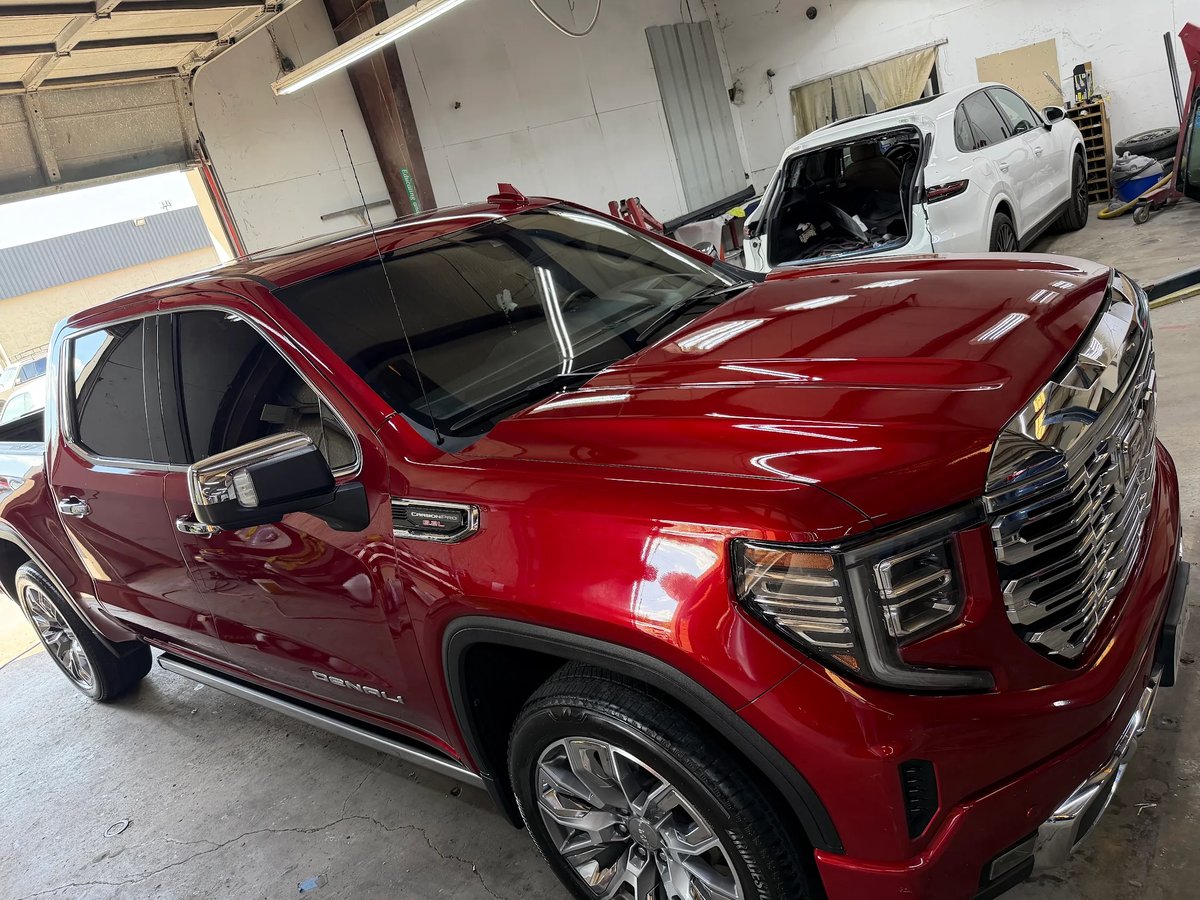
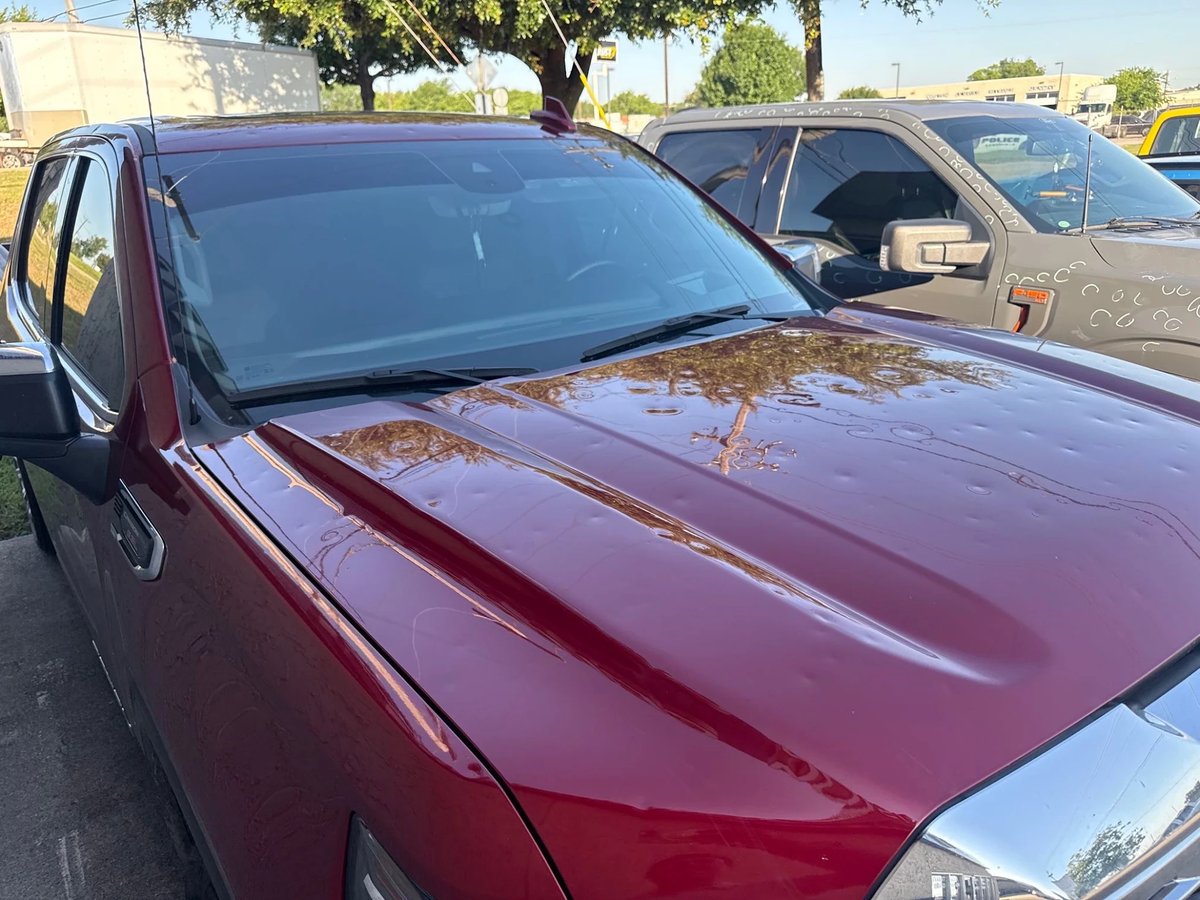
Drag the slider — a real full-vehicle hail repair from our Lewisville floor, the claim class that made up 52 of this report’s 90 files.
 Before
After
Before
After
Full-Vehicle Hail — Hood, Roof & Panels
Pictured: GMC Sierra Denali — full-vehicle hail repair completed on our Lewisville floor
State Farm Claim Questions